




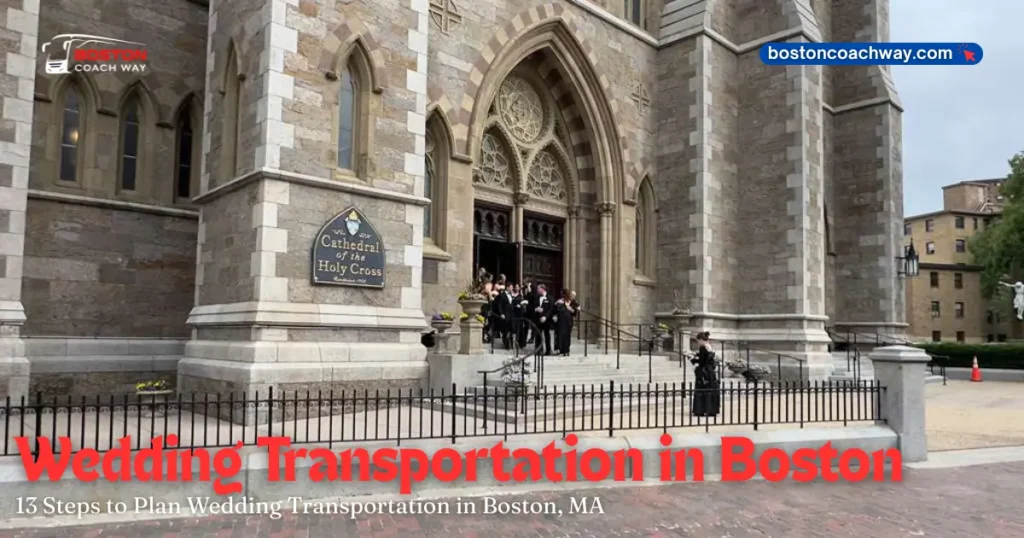
Wedding transportation is one of the most overlooked wedding logistics, yet proper planning can make the difference between a smooth celebration and a stressful wedding day. Planning wedding transportation in Boston involves much more than booking a vehicle. Couples need to coordinate guest movement, hotel pickups, ceremony and reception schedules, route planning, vehicle selection, budgets, and arrival times across multiple locations.
Boston presents unique transportation challenges, including traffic congestion, historic streets, limited parking, multiple venue locations, hotel blocks, and seasonal events that can affect travel times. Whether guests are arriving through Logan Airport, staying in Back Bay hotels, attending a waterfront reception in the Seaport District, or traveling between ceremony and reception venues, transportation logistics require careful coordination.
This guide walks through every step of wedding transportation planning in Boston. You’ll learn how to determine transportation needs, calculate guest counts, choose the right vehicle type, build a transportation timeline, manage hotel shuttles, account for Boston traffic, estimate costs, and select a transportation provider that can help keep your wedding day organized, efficient, and on schedule.
Table of Contents
1. Determine Whether You Need Wedding Transportation
You need wedding transportation in Boston when guests must travel between multiple locations, stay at hotel blocks, or face parking and traffic challenges on the wedding day. Determining this early helps shape every other transportation decision, including vehicle selection, scheduling, guest communication, and budgeting.
Transportation is often essential when the ceremony and reception take place at different venues, especially in areas such as Back Bay, Seaport, Cambridge, or Downtown Boston, where traffic congestion and limited parking can affect arrival times. It also becomes valuable for weddings with large guest counts, out-of-town attendees, and guests arriving through Logan International Airport.
On the other hand, transportation may not be necessary if the ceremony, reception, and accommodations are located within walking distance or on the same property. Smaller weddings with mostly local guests may also require fewer transportation arrangements.
A simple planning rule is to evaluate guest convenience. If transportation reduces parking issues, prevents navigation confusion, or helps guests arrive together and on time, it is usually worth including in your wedding transportation plan.
2. Identify Every Transportation Location
You should identify every transportation location before requesting quotes or building a wedding-day schedule. A complete location list helps create accurate routes, realistic travel times, and efficient vehicle assignments.
Start by listing all hotel locations where guests will stay. Then add the ceremony venue, reception venue, photography locations, after-party venues, Logan Airport pickup points, and any family pickup locations that require transportation support. Each location affects route planning, shuttle timing, and vehicle capacity requirements.
Many couples overlook secondary stops such as getting-ready locations, rehearsal dinner venues, or transportation for immediate family members. Missing even one location can create scheduling conflicts later in the planning process.
A simple transportation planning worksheet can include:
+ Hotel pickup locations
+ Ceremony venue
+ Reception venue
+ Photo session locations
+ After-party venue
+ Airport arrivals
+ Family pickup addresses
Once all locations are mapped, you can calculate travel times, identify traffic-sensitive routes, and build a transportation plan to keep the entire wedding day organized.
3. Calculate How Many Guests Need Transportation
You need to calculate how many guests actually need transportation before deciding on vehicle types or fleet size. Not every invited guest will use a shuttle, and overestimating or underestimating ridership can affect both costs and logistics.
Start by separating guests into categories. Local guests often drive themselves, while out-of-town guests staying at hotel blocks typically rely on provided transportation. Wedding party members, elderly guests, and family members are also more likely to use organized transportation throughout the day.
For many Boston weddings, hotel guests represent the highest shuttle usage rate. Destination-style celebrations and waterfront venues often see transportation participation rates ranging from 70% to 100%. Local weddings with ample parking may have lower participation rates.
Review RSVP responses and hotel room block reservations to estimate realistic ridership. This information helps determine whether a luxury SUV, Sprinter van, minibus, or charter bus is the most suitable option. Accurate guest counts reduce unnecessary transportation expenses and help maintain a reliable wedding-day schedule.
4. Choose the Right Vehicle Type
The right wedding vehicle depends on guest count, travel distance, comfort expectations, and how transportation will be used throughout the day. Choosing the correct vehicle improves efficiency and helps keep guests on schedule.
Luxury sedans work well for couples traveling between hotels, ceremony venues, and reception venues. SUVs provide additional space for wedding parties, family members, and luggage. Sprinter vans are popular for small groups because they combine passenger comfort with flexible routing.
Minibuses are often the preferred choice for transporting hotel guests to and from wedding venues. For larger weddings, charter buses offer higher passenger capacity, luggage storage, climate control, and fewer trips between locations. Limo coaches may also be suitable when transportation is part of the celebration experience.
The best vehicle is the one that matches actual transportation needs. Instead of selecting transportation based solely on appearance, focus on passenger count, route complexity, boarding efficiency, and overall guest experience. Proper vehicle selection supports every other step in the transportation planning process.
5. Establish a Transportation Budget
A wedding transportation budget should be based on guest count, vehicle requirements, rental duration, and the complexity of your transportation schedule. Establishing a realistic budget early helps prevent unexpected costs later in the planning process.
Vehicle type is usually the largest cost factor. Luxury sedans and SUVs generally serve smaller groups, while minibuses and charter buses are designed for larger groups. The number of vehicles required, total service hours, and travel distance also affect pricing.
Boston wedding transportation costs can increase during peak wedding season, particularly between May and October when demand is highest. Additional fees may include tolls, driver gratuities, parking charges, waiting time, and overtime if events run beyond the scheduled itinerary.
Many couples allocate approximately 2% to 8% of their total wedding budget toward transportation, depending on guest count and venue logistics. Creating a transportation budget before requesting quotes makes it easier to compare providers, prioritize services, and avoid overspending while maintaining guest convenience.
6. Build Your Wedding Transportation Timeline
A wedding transportation timeline ensures that vehicles, drivers, and guests move according to a coordinated schedule throughout the day. Building this timeline early helps reduce delays and supports smoother event logistics.
About 12 months before the wedding, begin researching transportation providers and estimating transportation needs. Around 6 months before the event, finalize guest counts, venue details, and preliminary route plans. At the 3-month mark, confirm pickup locations, vehicle types, and hotel block information.
One month before the wedding, review the complete transportation itinerary with venues, planners, and transportation providers. During wedding week, verify guest counts, route details, and driver contact information.
On the wedding day, transportation should operate according to preplanned pickup windows and arrival targets. Include buffer time between locations to account for boarding, unloading, and traffic conditions. A structured timeline helps maintain schedule accuracy while reducing stress for guests, wedding parties, and event coordinators.
7. Coordinate Hotel-to-Venue Transportation
Hotel-to-venue transportation helps guests arrive together, reduces parking pressure, and simplifies logistics for out-of-town attendees. For many Boston weddings, this is one of the most important transportation services to organize.
If guests are staying at a single hotel block, transportation planning is relatively straightforward. A scheduled shuttle can operate between the hotel and venue at predetermined departure times. When multiple hotel blocks are involved, a central pickup location may improve efficiency and reduce travel time.
Shuttle waves are often useful for larger weddings. For example, departures might occur at 3:00 PM, 3:30 PM, and 4:00 PM to accommodate different guest schedules while preventing overcrowding.
A sample transportation schedule could include hotel departures, estimated arrival times, return service windows, and driver contact information. Coordinating hotel-to-venue transportation carefully improves guest experience and helps maintain the overall wedding timeline, particularly when guests are unfamiliar with Boston road networks or venue locations.
8. Plan Transportation Between Ceremony and Reception Venues
Transportation between the ceremony and reception venues should be planned around travel time, boarding efficiency, and guest flow management. This becomes especially important when venues are located in different parts of Boston.
Start by calculating realistic travel times rather than relying solely on GPS estimates. Consider boarding time, unloading time, and expected traffic conditions. Building a 15-to-30-minute buffer into the schedule helps accommodate delays without disrupting reception activities.
For example, a ceremony in Back Bay followed by a reception in the Seaport District may require additional travel time during peak traffic periods. Similarly, travel between Cambridge and Downtown Boston can vary significantly depending on the time of day and local events.
Guest flow should also be considered. Coordinated departures prevent guests from arriving too early or too late. Clear loading instructions, designated pickup areas, and transportation staff coordination help maintain an organized transition between venues and contribute to a more seamless wedding experience.
9. Account for Boston Traffic and Event Congestion
You should account for Boston traffic and event congestion because travel delays can affect ceremony start times, guest arrivals, shuttle schedules, and reception timelines. Even short distances between venues can take significantly longer during busy periods.
Traffic challenges are common around Back Bay, Seaport, Fenway, Cambridge, and Downtown Boston. These areas experience frequent congestion due to commuter traffic, tourism, construction projects, and special events. Travel conditions can change quickly depending on the day and time of your wedding.
Seasonal events also influence transportation planning in Boston. Red Sox home games near Fenway Park can increase traffic and parking demand. College graduation season in May and June often brings heavy visitor activity around Boston universities. Summer tourism creates additional congestion near historic attractions, waterfront districts, and hotels. While the Boston Marathon and South Boston St. Patrick’s Day Parade have already passed in 2026, couples planning future weddings should consider potential road closures and event-related traffic.
Building an additional 15 to 30 minutes into transportation schedules helps reduce the impact of unexpected delays and keeps wedding-day logistics running smoothly.
10. Plan End-of-Night Guest Transportation
End-of-night guest transportation should be planned before the wedding day so guests have a safe and reliable way to return to hotels, homes, or after-party locations. Many couples focus on arrival transportation but overlook departure logistics.
Return shuttles are often the simplest solution for weddings where guests stay at hotel blocks. Instead of scheduling a single departure, consider multiple return times throughout the evening. This allows older guests, families with children, and guests who prefer an earlier departure to leave comfortably without disrupting the celebration.
For example, return shuttle departures could be scheduled at 9:30 PM, 10:30 PM, and after the reception concludes. This approach reduces crowding and improves guest convenience. If an after-party is planned, transportation can also be scheduled between the reception venue and the after-party location before providing final hotel drop-offs.
A clear departure strategy helps prevent confusion, reduces rideshare demand, and ensures guests can enjoy the celebration without worrying about transportation at the end of the night.
11. Communicate Transportation Details to Guests
You need to communicate transportation details clearly and repeatedly so guests know exactly where to go, when to arrive, and how transportation will operate on the wedding day. Good communication prevents missed shuttles, late arrivals, and unnecessary confusion.
Start by adding transportation information to your wedding website. Include pickup locations, departure times, hotel shuttle schedules, and transportation contact information. Invitations and RSVP materials can also direct guests to transportation details online.
Welcome bags placed in hotel rooms provide another opportunity to share schedules and pickup instructions. As the wedding approaches, send reminder emails or text messages to confirm transportation arrangements.
Simple wording works best. For example:
“Shuttle service will depart from the hotel lobby at 3:15 PM and 3:45 PM. Please arrive 10 minutes before departure.”
“Return transportation will be available outside the reception venue beginning at 9:30 PM.”
Clear communication helps guests stay on schedule and supports a smoother transportation experience throughout the wedding day.
12. Confirm Everything One Week Before the Wedding
You should confirm every transportation detail one week before the wedding to identify potential issues while there is still time to make adjustments. This final review helps ensure that schedules, routes, and vehicle assignments match your latest plans.
Use a simple transportation checklist:
+ Confirm pickup times and departure schedules
+ Verify driver names and contact information
+ Review final guest counts
+ Reconfirm hotel block transportation needs
+ Verify the ceremony and reception addresses
+ Confirm route plans and estimated travel times
+ Review loading and unloading locations
+ Confirm venue contact information
+ Verify emergency contact details
This is also the ideal time to notify transportation providers about last-minute guest changes, venue updates, or revised schedules. Traffic patterns, construction zones, and special events can change quickly in Boston, so route confirmations are especially important.
A thorough final review reduces wedding-day surprises and helps transportation operate according to plan from the first pickup to the final drop-off.
13. Finalize Your Transportation Provider
You should finalize your transportation provider after reviewing contracts, confirming services, and verifying that every transportation requirement has been documented correctly. This step officially locks in the transportation plan for your wedding day.
Begin by reviewing the transportation contract carefully. Confirm service hours, vehicle types, pickup locations, cancellation policies, overtime fees, and payment schedules. Any verbal agreements should also appear in writing.
Next, verify licensing, insurance coverage, and fleet availability. Confirm that the vehicles reserved for your wedding match your transportation needs and guest count. If ADA-accessible transportation or special accommodations are required, verify those arrangements as well.
Request emergency contact information for dispatch personnel or transportation coordinators who can assist if unexpected issues arise. Finally, review and approve the complete transportation itinerary, including routes, schedules, and passenger pickup locations.
Completing these final checks provides confidence that transportation logistics are fully organized and ready to support a smooth, well-coordinated wedding day.
When Should You Book Wedding Transportation in Boston?
You should book wedding transportation in Boston as soon as your venue, wedding date, and estimated guest count are confirmed. Transportation availability can change significantly throughout the year, and waiting too long may limit vehicle options, especially during peak wedding season.
The busiest wedding season in Boston typically runs from May through October. During these months, transportation providers experience higher demand due to weddings, corporate events, graduations, tourism, and seasonal travel. Couples planning weddings during peak season should secure transportation earlier to access the best vehicle selection and scheduling flexibility.
The off-season generally runs from November through April. Availability is often better during this period, although holiday weekends and special events can still affect demand.
Recommended booking windows vary based on wedding size and transportation complexity:
Wedding Type | Recommended Booking Window |
Small Wedding | 3–6 months before |
Large Wedding | 6–9 months before |
Peak Season Wedding | 9–12 months before |
A good planning rule is to book wedding transportation shortly after securing your venue. Early booking provides more flexibility for route planning, hotel shuttle coordination, vehicle selection, and guest transportation logistics across Boston and surrounding Massachusetts destinations.
How Much Does Wedding Transportation Cost in Boston?
Wedding transportation in Boston typically costs between $600 and $4,500+, depending on vehicle type, guest count, service hours, and route complexity. A luxury sedan for the couple may cost $600–$1,200, while a Sprinter van or minibus often ranges from $900–$2,500. Larger weddings requiring a charter bus can cost $1,500–$4,500+.
Costs increase when multiple vehicles, hotel shuttles, multiple pickup locations, extended service hours, or late-night transportation are needed. Additional expenses may include tolls, parking fees, driver gratuities, and overtime charges. The most accurate estimate comes from matching your guest count, venue locations, and transportation schedule to the appropriate vehicle type.
Is a Bus or a car better for a Wedding in Boston?
A bus is usually better for transporting wedding guests, while a car is better for transporting the couple or a small group. The best choice depends on guest count, transportation goals, venue locations, and overall wedding logistics.
Factor | Car (Sedan/SUV) | Bus (Minibus/Charter Bus) |
Best For | Couple, immediate family, small wedding party | Wedding guests, large groups, hotel shuttles |
Typical Capacity | 2–7 passengers | 15–56+ passengers |
Cost Efficiency | Better for small groups | Better for medium and large groups |
Parking Requirements | Minimal | Requires designated loading areas |
Hotel-to-Venue Transportation | Limited | Excellent |
Multiple Guest Pickups | Not practical | Designed for it |
Group Coordination | Difficult with multiple vehicles | Keeps everyone on the same schedule |
Out-of-Town Guests | Limited capacity | Ideal for hotel blocks and airport arrivals |
Traffic Management | Multiple vehicles increase coordination | Fewer vehicles simplify logistics |
Guest Experience | Private and premium | Organized and convenient |
Best Wedding Size | Under 10 passengers | 15+ passengers |
Common Boston Use Case | Couple transportation between venues | Guest transportation between hotels, the ceremony, and the reception |
For most Boston weddings, a combination of both options works best. Many couples use a luxury sedan or SUV for themselves and reserve a minibus or charter bus for guest transportation. This approach improves scheduling, reduces parking challenges, and helps guests arrive together despite Boston traffic and venue access restrictions.
Are ADA-Accessible Wedding Transportation Options Available?
Yes, ADA-accessible wedding transportation options are available in Boston and should be arranged as early as possible. ADA-compliant buses typically include wheelchair lifts or ramps, secure wheelchair positions, wider entryways, and accessible seating areas for guests using wheelchairs, walkers, mobility scooters, or other mobility devices.
When planning transportation, confirm vehicle availability, lift capacity, boarding procedures, and accessibility accommodations at both pickup and drop-off locations. Including accessible transportation in your wedding plan helps ensure every guest can travel comfortably between hotels, ceremony venues, and reception venues without mobility-related barriers.
What Are the Common Wedding Transportation Mistakes to Avoid?
Avoiding common transportation mistakes helps keep guests on schedule, reduces stress, and prevents last-minute logistical problems. The most frequent 13 wedding transportation mistakes include:
1. Booking Transportation Too Late
Waiting too long can limit vehicle availability, especially during Boston’s peak wedding season from May through October.
2. Choosing the Wrong Vehicle Size
Selecting a vehicle without accurately estimating ridership can lead to overcrowding, multiple unnecessary trips, or wasted transportation budget.
3. Underestimating Guest Transportation Needs
Many couples assume guests will drive themselves when a large percentage may actually rely on hotel shuttles or group transportation.
4. Ignoring Boston Traffic Conditions
Traffic congestion in Back Bay, Seaport, Fenway, Cambridge, and Downtown Boston can significantly increase travel times.
5. Not Building Buffer Time Into the Schedule
Tight transportation schedules leave little room for delays caused by boarding, traffic, weather, or venue logistics.
6. Forgetting Return Transportation
Planning arrivals without organizing return shuttles can leave guests struggling to find transportation after the reception.
7. Overlooking Hotel-to-Venue Logistics
Poor coordination between hotels and venues can create missed pickups, delayed arrivals, and guest confusion.
8. Failing to Map All Transportation Locations
Missing photo locations, airport pickups, after-parties, or family pickup points can disrupt the transportation plan.
9. Poor Guest Communication
Guests need clear pickup locations, departure times, and transportation instructions before the wedding day.
10. Not Confirming Details Before the Wedding
Failing to verify schedules, guest counts, routes, and driver contacts one week before the wedding increases the risk of mistakes.
11. Ignoring Accessibility Requirements
Waiting until the last minute to arrange ADA-accessible transportation may limit available vehicle options.
12. Focusing Only on Cost
Choosing transportation solely based on price can result in reliability issues, limited fleet options, or poor guest experience.
13. Not Having an Emergency Contact Plan
Every transportation schedule should include dispatch contacts and emergency communication procedures in case of unexpected changes.
How to Choose the Right Wedding Transportation Company in Boston
Choosing the right wedding transportation company in Boston starts with evaluating experience, safety, fleet quality, and local expertise. The best providers do more than supply vehicles. They help coordinate routes, schedules, guest movement, and transportation logistics throughout the wedding day.
Step 1: Look for Wedding Transportation Experience
Choose a company that regularly handles weddings. Experienced providers understand hotel blocks, ceremony-to-reception transfers, guest flow management, and wedding-day timelines.
Step 2: Evaluate Fleet Options
Review the available fleet to ensure it matches your transportation needs. A quality provider should offer sedans, SUVs, Sprinter vans, minibuses, charter buses, and ADA-accessible vehicles when needed.
Step 3: Verify Licensing and Insurance
Confirm that the company is properly licensed, insured, and operates commercial vehicles legally. This is one of the most important safety checks.
Step 4: Read Reviews and Testimonials
Look for reviews that mention punctuality, vehicle cleanliness, driver professionalism, communication, and overall reliability.
Step 5: Assess Local Boston Knowledge
Choose a provider familiar with Back Bay, Seaport, Fenway, Cambridge, Downtown Boston, Logan Airport, and common wedding venues. Local route knowledge helps reduce transportation delays.
Step 6: Ask About Transportation Planning Support
The best companies help with route planning, hotel shuttle coordination, multiple pickup locations, transportation timelines, and guest logistics.
Step 7: Review Pricing and Contract Details
Make sure pricing is transparent and includes service hours, overtime policies, gratuities, cancellation terms, and any additional fees.
Step 8: Evaluate Customer Support
Responsive communication is essential. Your provider should be easy to reach before and during the wedding in case schedules or guest counts change.
Step 9: Confirm Emergency and Backup Plans
Ask how the company handles vehicle issues, traffic disruptions, driver emergencies, or last-minute schedule adjustments.
Step 10: Compare Providers Using a Checklist
Before booking, confirm:
✓ Wedding transportation experience
✓ Diverse and well-maintained fleet
✓ Proper licensing and insurance
✓ Positive customer reviews
✓ Boston traffic and route knowledge
✓ ADA-accessible options if needed
✓ Transportation planning assistance
✓ Transparent pricing and contracts
✓ Responsive customer support
✓ Emergency contact availability
A reliable wedding transportation company should function as a logistics partner, helping coordinate guest transportation, schedules, and routes so your wedding day runs smoothly from the first pickup to the final drop-off.

Can Transportation Companies Help With Route Planning?
Yes, professional transportation companies can help with route planning by coordinating pickup locations, venue access, hotel shuttles, and travel schedules. They optimize routes based on traffic patterns, road closures, construction, and event congestion throughout Boston. Experienced providers also coordinate with venues and hotels, manage multiple stops, and build efficient transportation schedules that help guests arrive on time while reducing delays and unnecessary travel throughout the wedding day.