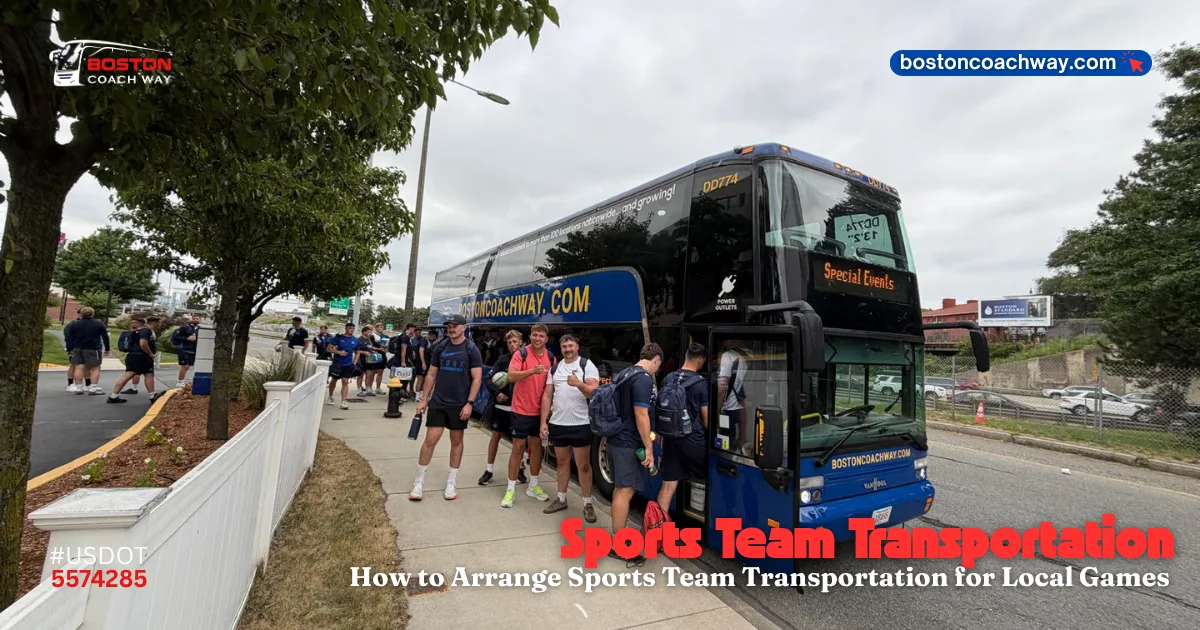
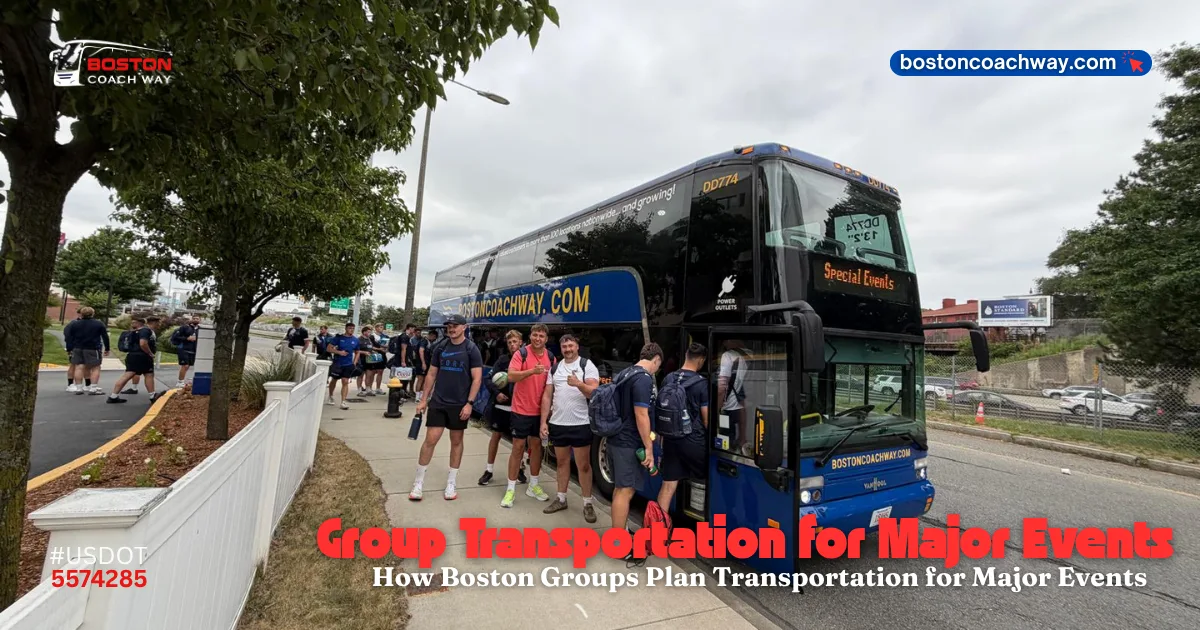



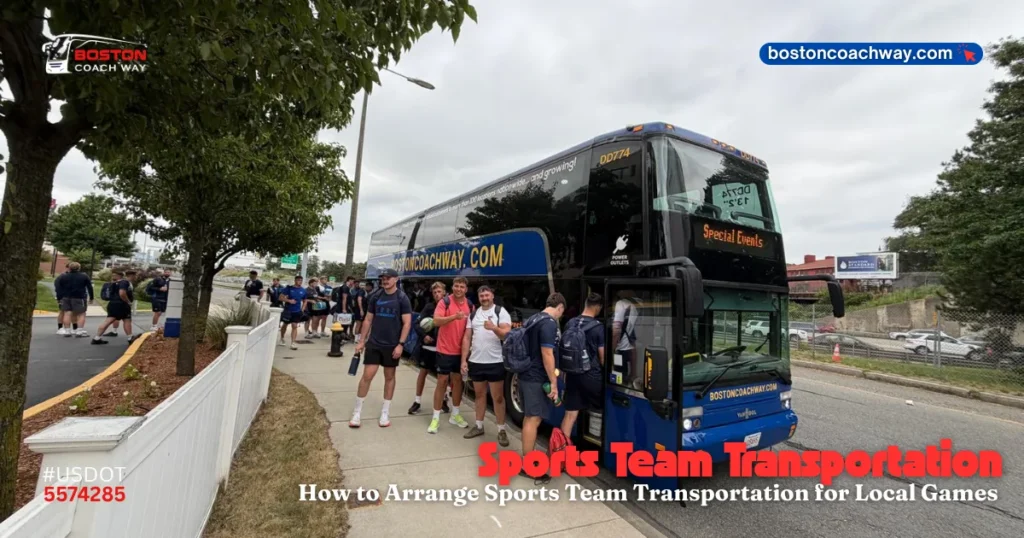
Arranging sports team transportation in Massachusetts starts with planning passenger numbers, choosing the right vehicle, estimating equipment storage, and setting convenient pickup times and locations. Coaches, athletic directors, and sports organizers must also coordinate travel schedules, compare transportation providers, and account for the needs of different sports teams.
In this guide, you’ll learn how to plan group transportation for local games and tournaments, select suitable vehicles, estimate rental costs, and prepare a game-day itinerary. You’ll also discover how local game transportation differs from tournament travel and how to avoid common transportation problems, helping your team travel safely, stay organized, and arrive at sporting events on schedule.
Table of Contents
Why Is Organized Transportation Important for Local Sports Teams?
Organized transportation helps local sports teams travel together, arrive on time, and manage game-day logistics efficiently. A coordinated travel plan keeps athletes, coaches, trainers, and team staff on the same schedule while reducing separate vehicle arrangements. It also provides space for sports equipment, supports passenger accountability, and simplifies communication between team organizers and drivers. For youth leagues, school teams, and athletic clubs, planned group transportation makes pickup, venue arrival, and post-game return easier to coordinate across local Massachusetts communities.
How to Arrange Transportation for Local Sports Teams?
To arrange transportation for local sports teams, follow these planning steps: confirm the game schedule, calculate passenger numbers, choose a suitable vehicle, assess equipment storage, select pickup locations, create a travel schedule, evaluate transportation providers, compare quotes, and confirm the booking. Each step helps coaches, athletic directors, and sports organizers coordinate group travel around the team’s schedule, passenger needs, and destination.
1. Confirm the Game Schedule and Transportation Requirements
Start by confirming the game schedule, venue address, team arrival time, and expected return time. Identify whether the trip involves a single game, a recurring local league schedule, or multiple sporting events. For Boston-area teams, confirm the exact destination, whether the venue is in Boston, Cambridge, Quincy, Newton, or another Massachusetts community, and how long the journey takes from the pickup point. Check the venue’s bus entrance, parking arrangements, and loading restrictions. Also record the required departure time, warm-up period, passenger count, equipment needs, and any accessibility requirements. These details establish the transportation requirements for the entire trip.
2. Calculate the Total Number of Passengers
Calculate the total passenger count before selecting a vehicle or requesting a transportation quote. Include every person traveling with the team, not just the athletes. Coaches, assistant coaches, athletic trainers, team managers, chaperones, and other approved staff also require seats.
Use the following formula:
Total passengers = Athletes + Coaches + Trainers + Team staff + Chaperones
For example, a school soccer team with 20 athletes, 1 head coach, 2 assistant coaches, 1 athletic trainer, and 1 team manager has 25 passengers. Confirm the final headcount with the team roster and account for any parents or additional staff traveling with the group. An accurate passenger count helps determine vehicle capacity and prevents seating shortages.
3. Choose the Right Vehicle for Your Sports Team
Choose a vehicle based on the number of passengers, equipment requirements, travel distance, and available storage space. A full-size charter bus suits larger teams, while a minibus or passenger van may accommodate smaller groups. The vehicle’s seating capacity alone does not determine suitability. Athletes and staff also need sufficient room for personal belongings and sports equipment.
The following vehicle types serve different team transportation requirements:
Vehicle Type | Typical Capacity | Suitable For |
Full-size charter bus | Approximately 40–56 passengers | Large school teams, football squads, and multi-team travel |
Minibus | Approximately 15–30 passengers | Youth teams, basketball teams, and smaller athletic groups |
Passenger or Sprinter van | Varies by seating configuration | Small teams, coaching staff, and limited-equipment trips |
Actual passenger capacity depends on the vehicle’s configuration. Confirm seating and luggage capacity with the provider before booking, particularly when the team carries bulky equipment.
4. Estimate Sports Equipment and Storage Requirements
Estimate the size, quantity, and storage needs of sports equipment before choosing a vehicle. Football teams carry helmets, shoulder pads, and protective gear, while hockey teams transport sticks, goalie pads, and equipment bags. Soccer teams may travel with balls, uniforms, cones, and training supplies.
Create an equipment inventory that includes:
- Protective equipment: Helmets, shoulder pads, shin guards, and goalie pads.
- Playing equipment: Footballs, soccer balls, basketballs, bats, and hockey sticks.
- Team supplies: Uniform bags, first-aid kits, water coolers, and training equipment.
- Personal belongings: Backpacks, duffel bags, and clothing.
Ask the transportation provider about undercarriage luggage bays, overhead storage, and other available cargo areas. Confirm that the equipment fits without blocking passenger aisles, emergency exits, or seating areas. Separate and label team bags to make loading and unloading easier at the venue.
5. Select Convenient Pickup and Drop-Off Locations
Choose pickup and drop-off locations that provide safe boarding, sufficient vehicle access, and convenient connections to the team’s school or training facility. Common pickup points include school parking lots, athletic complexes, community centers, and designated meeting areas.
For Boston-area transportation, consider road access and traffic conditions around neighborhoods and destinations such as downtown Boston, Fenway, Allston, Cambridge, and Brookline. A large charter bus may require more turning and loading space than a passenger van. Confirm the venue’s designated bus entrance, parking rules, and unloading area before finalizing the route. Share the exact pickup address and meeting instructions with athletes, parents, and team staff.
6. Build a Transportation Schedule Around Game Time
Build the transportation schedule backward from the team’s required arrival time at the venue. Include time for passenger check-in, boarding, equipment loading, road travel, and pre-game preparation. The schedule should also account for traffic conditions and the distance between the pickup location and the sporting venue.
For example, a team playing a 3:30 PM soccer game may plan to arrive at the venue by 2:00 PM. An illustrative schedule could include:
Activity | Planned Time |
Passenger check-in | 12:30 PM |
Boarding and equipment loading | 12:30–12:45 PM |
Departure | 12:45 PM |
Estimated venue arrival | 1:30 PM |
Equipment unloading and team preparation | 1:30–2:00 PM |
Game begins | 3:30 PM |
Return departure | After the game |
These times are illustrative. Adjust departure and arrival targets based on the actual route, traffic, venue access, and warm-up requirements. Include a return-trip plan that accounts for overtime, weather delays, and changes to the game schedule.
7. Select a Reliable Sports Transportation Provider
Select a transportation provider based on vehicle suitability, driver qualifications, insurance, maintenance practices, and experience handling group travel. Sports team transportation involves more than moving passengers between two locations. The provider must understand the team’s schedule, equipment requirements, pickup arrangements, and return-trip expectations.
Evaluate these factors before making a decision:
- Vehicle condition: Confirm that the vehicle is maintained and suitable for the planned journey.
- Driver qualifications: Ask about the driver’s licensing, qualifications, and experience with group transportation.
- Insurance: Verify that the provider carries appropriate commercial passenger transportation insurance.
- Equipment storage: Confirm that the vehicle has enough designated storage for the team’s gear.
- Schedule coordination: Check how the provider handles traffic delays, extended games, and return-time changes.
- Accessibility: Discuss wheelchair access and other passenger accommodation requirements.
For school transportation, confirm that the proposed service meets the school’s transportation policies and applicable Massachusetts requirements. Request relevant documentation before confirming the booking.
8. Compare Transportation Providers and Request Quotes
Request written quotes from multiple transportation providers using the same trip details. A consistent request makes it easier to compare vehicle options, included services, and total rental costs. Provide the passenger count, pickup and drop-off addresses, travel date, departure time, estimated return time, equipment requirements, and any additional stops.
Compare each quote using these cost and service details:
Quote Detail | What to Check |
Vehicle type | Bus size, seating capacity, and storage space |
Rental duration | Minimum rental hours and additional waiting time |
Distance | Included mileage and extra-mileage charges |
Additional costs | Tolls, parking, fuel surcharges, and other fees |
Schedule changes | Overtime rates and return-time flexibility |
Booking terms | Deposit, cancellation policy, and payment deadlines |
For example, if a group transportation quote totals $900 for 30 passengers, the illustrative cost is $30 per passenger. However, compare the full quoted price and included services rather than choosing a provider based only on the initial rate.
9. Confirm the Booking and Distribute the Itinerary
Confirm the reservation after reviewing the vehicle details, total price, pickup arrangements, and booking terms. Request written confirmation that includes the transportation date, passenger capacity, pickup address, destination, departure time, return arrangements, and provider contact information.
Distribute a clear itinerary to coaches, athletes, parents, chaperones, and relevant school staff. Include:
- Game date, venue address, and scheduled start time.
- Pickup location and passenger check-in time.
- Departure time and expected venue arrival.
- Equipment loading instructions.
- Driver or transportation coordinator contact details.
- Return-trip arrangements and procedures for schedule changes.
Finalize the passenger list before departure and assign a team representative to check attendance and equipment. Clear communication gives everyone the same travel information and helps prevent missed pickups, boarding delays, and confusion after the game.
How Does Local Game Transportation Differ from Tournament Transportation?
Local game transportation focuses on short, scheduled trips between a team’s regular meeting point and a nearby sports venue. Tournament transportation requires more complex planning because teams may travel to multiple venues, play over several days, and need accommodation, meals, and equipment storage. The differences affect vehicle selection, travel schedules, rental duration, passenger coordination, and overall transportation costs.
The following table compares the main transportation requirements for local games and tournaments.
Planning Factor | Local Game Transportation | Tournament Transportation |
Travel Distance | Usually involves travel within the same city or nearby Massachusetts communities. | May involve longer journeys to regional or out-of-state destinations. |
Trip Duration | Commonly covers a single round trip on game day. | May require transportation over multiple days or an entire tournament weekend. |
Game Schedule | Organized around one scheduled game, including arrival and return times. | Coordinates multiple games, match intervals, warm-ups, and changing schedules. |
Vehicle Requirements | A minibus, school bus, passenger van, or charter bus based on team size and equipment. | Often requires a charter bus or other vehicle with sufficient passenger and equipment capacity for extended travel. |
Equipment Storage | Accommodates uniforms, sports bags, balls, and sport-specific gear for one game. | Requires storage for equipment, uniforms, personal luggage, and supplies for multiple games. |
Pickup and Drop-Off | Usually uses one pickup point and one sporting venue. | May involve hotels, tournament venues, restaurants, training facilities, and other scheduled stops. |
Scheduling | Focuses on departure, venue arrival, game time, and post-game return. | Requires coordination across several days, multiple departure times, and changing match schedules. |
Accommodation and Meals | Usually does not require overnight accommodation or planned meal stops. | May require hotel transfers, meal breaks, and coordination with the tournament itinerary. |
Rental Duration | Often requires a few hours or a single day, depending on the game schedule. | May require a multi-day rental or repeated transportation services. |
Cost Considerations | Depends on vehicle type, mileage, rental hours, and additional charges. | Includes longer travel distances, extended rental periods, additional stops, waiting time, and possible overnight arrangements. |
The main difference is the complexity and duration of the travel plan. Local games generally require straightforward round-trip coordination, while tournaments require a multi-day transportation schedule that accounts for changing game times, multiple destinations, passenger needs, and equipment logistics.
What Transportation Options Are Best for Different Sports Teams?
The best transportation option for a sports team depends on its passenger count, equipment volume, travel distance, and game schedule. A full-size charter bus accommodates larger teams and extensive equipment, while a minibus suits smaller squads traveling to local venues. Passenger vans work for small groups with limited gear. Schools, athletic directors, and coaches can compare the following options to match the vehicle with their team’s travel requirements.
Sports Team | Recommended Transportation | Typical Capacity | Equipment and Storage Requirements | Best For |
Football Teams | Full-size charter bus | Approximately 40–56 passengers | Helmets, shoulder pads, uniforms, footballs, and large equipment bags require dedicated storage. | High school, college, and larger football squads |
Soccer Teams | Minibus or charter bus | Approximately 18–56 passengers | Soccer balls, uniforms, shin guards, cleats, and team bags require organized luggage space. | Youth leagues, school teams, and competitive soccer clubs |
Basketball Teams | Minibus or passenger van | Varies by configuration | Basketballs, uniforms, shoes, and personal bags require moderate storage space. | School teams and smaller basketball squads |
Baseball and Softball Teams | Charter bus or minibus | Approximately 18–56 passengers | Bats, helmets, gloves, catcher’s gear, uniforms, and equipment bags require suitable cargo storage. | School teams, travel leagues, and tournament groups |
Hockey Teams | Full-size charter bus | Approximately 40–56 passengers | Hockey sticks, goalie pads, helmets, skates, and bulky equipment bags require substantial storage space. | School, club, and competitive hockey teams |
Lacrosse Teams | Charter bus or minibus | Approximately 18–56 passengers | Lacrosse sticks, helmets, protective pads, gloves, and team bags require dedicated storage. | Youth, high school, and college teams |
Volleyball Teams | Minibus or charter bus | Approximately 18–56 passengers | Volleyballs, uniforms, knee pads, shoes, and personal bags require moderate storage space. | School teams and club volleyball groups |
Track and Field Teams | Full-size charter bus or minibus | Approximately 18–56 passengers | Running gear, uniforms, hurdles, poles, and event-specific equipment require storage based on the team’s disciplines. | School athletic programs and multi-event teams |
Capacity ranges are general vehicle examples, not guaranteed seating availability. Actual capacity and luggage space vary by vehicle configuration and provider.
How to Choose the Right Transportation Option for a Sports Team?
Choose the right sports team transportation by comparing passenger capacity, equipment storage, travel distance, accessibility, pickup locations, and rental costs. Use this step-by-step bus rental checklist to match the vehicle with your team’s travel requirements.
1. Match Vehicle Capacity to the Team Size
Count all athletes, coaches, trainers, managers, and chaperones. Select a vehicle with enough seats for the entire group.
2. Check Sports Equipment Storage Capacity
List the team’s equipment, including helmets, bats, sticks, pads, and sports bags. Confirm that the vehicle has enough designated storage space.
3. Consider Travel Distance and Trip Duration
Match the vehicle to the journey length, planned stops, and rental duration. Consider a minibus for nearby games and a charter bus for larger groups or longer trips.
4. Evaluate Passenger Accessibility Requirements
Identify mobility needs among athletes and staff. Confirm wheelchair access, lifts, designated spaces, and suitable boarding arrangements with the provider.
5. Review Pickup Locations and Venue Access
Choose pickup and drop-off points with sufficient space for the selected vehicle. Check road access, traffic conditions, loading areas, and bus parking near the sports venue.
6. Compare Rental Costs and Included Services
Request written quotes using the same passenger count, route, and schedule. Compare mileage, rental hours, waiting time, tolls, parking, and additional charges.
7. Verify Provider and Vehicle Requirements
Check the provider’s commercial insurance, driver qualifications, vehicle maintenance, and booking terms. Confirm that the vehicle meets the team’s seating, storage, and scheduling requirements.
How Far in Advance Should You Book Sports Team Transportation?
Book sports team transportation at least 2–4 weeks before a local game to secure a suitable vehicle and coordinate pickup times, routes, and equipment storage. For tournaments, large teams, peak-season games, or trips requiring multiple vehicles, aim to book 1–3 months in advance.
Early booking gives coaches and athletic directors more time to compare providers, review quotes, confirm vehicle capacity, and distribute travel itineraries. If the game schedule changes, notify the provider as soon as possible to check availability and update the reservation.

How Do You Coordinate Transportation on Game Day?
Coordinate transportation on game day by following a confirmed itinerary, maintaining communication, and checking passengers and equipment at each stage. Assign a team representative to manage boarding, confirm the final passenger count, and ensure all athletes, coaches, and staff are present before departure.
Share the driver’s contact details, pickup locations, and arrival times with relevant team members. Allow extra travel time for traffic and venue access. After the game, confirm the return pickup point and account for every passenger before leaving the venue.
What Common Sports Team Transportation Problems Should Organizers Avoid?
Sports organizers should avoid common transportation problems such as late departures, inaccurate passenger counts, insufficient equipment storage, unsuitable vehicles, and unclear pickup arrangements. Other issues include failing to account for traffic, overlooking venue parking restrictions, and not allowing enough time for pregame warm-ups.
Poor communication between coaches, parents, drivers, and team representatives can also cause confusion. Confirming the itinerary, vehicle capacity, equipment requirements, and return arrangements in advance helps prevent delays and keeps team travel organized.