


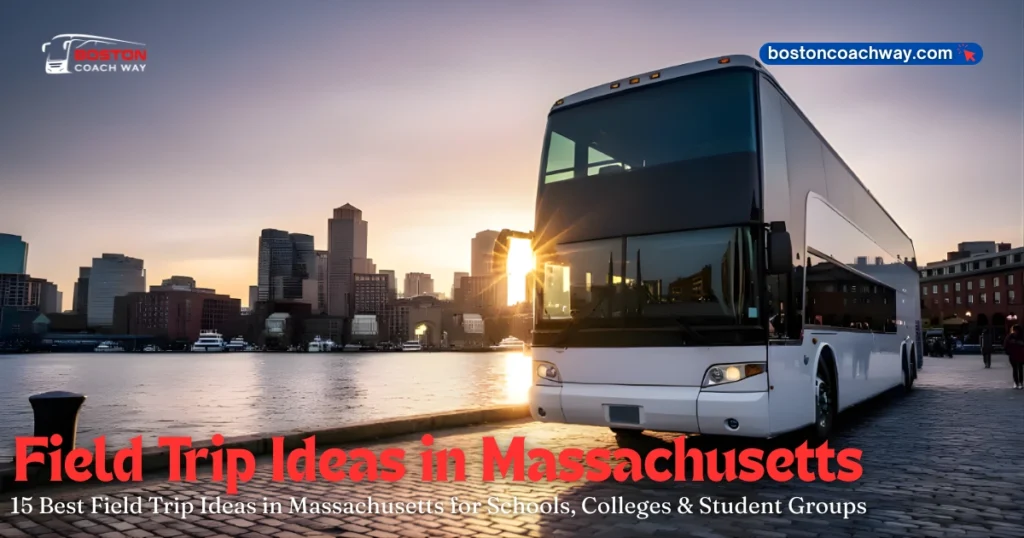
Massachusetts is one of the best states in the U.S. for educational field trips because it combines American history, STEM innovation, marine science, university culture, arts, and outdoor learning within a relatively small travel region. School groups can explore Revolutionary War landmarks in Boston, visit science museums and aquariums, tour world-famous universities in Cambridge, and experience hands-on learning through living-history villages, wildlife parks, and interactive museums across the state.
This guide covers field trip ideas for elementary schools, middle schools, high schools, colleges, universities, homeschool groups, and youth organizations. It also helps teachers and coordinators plan educational travel more efficiently by comparing indoor and outdoor destinations, grade-level suitability, subject-focused trips, seasonal planning, and group transportation considerations throughout Massachusetts.
Table of Contents
1. Freedom Trail
Location: Boston, Massachusetts
Best For: Middle school, high school, homeschool groups, college history programs
Educational Focus: American Revolution, colonial Boston, civics, political history
Best Season: Spring and fall
The Freedom Trail is one of the most valuable history field trips in Massachusetts because students can follow the real locations connected to the American Revolution instead of only reading about them in class. The trail stretches through downtown Boston and links churches, meeting halls, cemeteries, and historic buildings that shaped early American independence. Teachers often choose this trip to make colonial history, government, and civic education feel more visual and memorable for students.
Students commonly stop at Faneuil Hall, Old North Church, and Paul Revere House during guided educational tours. The walkable route also helps students understand how geography, trade, and public gathering spaces influenced revolutionary events in Boston. Because many landmarks sit close together, schools can organize half-day or full-day learning itineraries without complicated transportation planning.
2. Museum of Science
Location: Boston, Massachusetts
Best For: Elementary school, middle school, STEM academies, science clubs
Educational Focus: Engineering, astronomy, physics, biology, technology
Best Season: Year-round
The Museum of Science gives students an interactive learning experience centered around experimentation, engineering, and scientific discovery. Instead of static exhibits, students can participate in live demonstrations, explore technology-focused displays, and observe scientific principles through hands-on activities. This makes the museum one of the strongest STEM field trip destinations in Massachusetts for both younger students and advanced academic groups.
Popular attractions include the Hayden Planetarium, engineering exhibits, and the Theater of Electricity, where students observe high-voltage scientific demonstrations. Schools often use the museum to support classroom units related to robotics, energy, ecosystems, and space science. The indoor layout also makes it a reliable option for winter educational travel and rainy-day field trips across Massachusetts.
3. New England Aquarium
Location: Boston Waterfront, Massachusetts
Best For: Elementary schools, middle schools, biology programs, homeschool groups
Educational Focus: Marine biology, ocean conservation, environmental science
Best Season: Year-round
The New England Aquarium helps students explore marine ecosystems through immersive exhibits focused on ocean life and environmental conservation. Students can observe aquatic species from different regions of the world while learning how climate change, pollution, and habitat loss affect marine environments. The experience supports science curriculum topics related to biology, ecology, and sustainability.
The Giant Ocean Tank remains one of the aquarium’s most popular educational features because students can observe coral reef ecosystems, sea turtles, and tropical fish within a multi-level viewing environment. Interactive touch tanks and educational presentations also encourage hands-on learning. The aquarium’s location near Boston Harbor makes it easy for schools to combine the visit with waterfront educational activities and nearby museums.
4. MIT Museum
Location: Cambridge, Massachusetts
Best For: High school students, college STEM programs, robotics clubs
Educational Focus: Robotics, artificial intelligence, engineering, innovation
Best Season: Year-round
The MIT Museum introduces students to innovation, engineering, and emerging technology through exhibits connected to real scientific research. Many high schools and university programs choose this field trip because it exposes students to modern inventions, robotics, artificial intelligence, and creative problem-solving in an academic environment shaped by one of the world’s leading technology institutions.
Students can explore interactive robotics displays, holography projects, and technology exhibits connected to MIT research initiatives. The museum also encourages career-focused learning by helping students understand how engineering and computer science influence healthcare, transportation, architecture, and communication systems. Many schools pair the museum with nearby university tours to create broader STEM-focused educational experiences in Cambridge.
5. Harvard University
Location: Cambridge, Massachusetts
Best For: High school students, college groups, international student programs
Educational Focus: Higher education, research culture, academic history
Best Season: Spring and fall
Harvard University gives students an opportunity to experience one of the most influential academic environments in the United States. Visiting the campus helps students understand university culture, academic expectations, and research-driven learning while exploring historic buildings, libraries, museums, and student spaces. High schools often organize Harvard tours to encourage college readiness and long-term academic motivation.
Walking through Harvard Yard introduces students to centuries of educational history connected to law, medicine, politics, literature, and science. Schools also use the trip to expose students to campus life before college applications begin. Nearby attractions like Harvard museums and Cambridge academic institutions can easily expand the educational experience into a full-day itinerary.
6. Plimoth Patuxet Museums
Location: Plymouth, Massachusetts
Best For: Elementary schools, middle schools, social studies programs
Educational Focus: Colonial America, Indigenous history, cultural education
Best Season: Spring and fall
Plimoth Patuxet Museums creates a hands-on history experience by recreating daily life in 17th-century New England. Students can interact with historical interpreters, observe traditional building methods, and learn how Indigenous communities and English settlers lived during early colonial America. The museum helps transform textbook history into a more immersive learning experience.
Students often explore recreated colonial homes, farming areas, and Wampanoag cultural exhibits during guided educational tours. The museum also supports discussions about early settlement challenges, agriculture, trade, and cultural interaction in New England. Outdoor demonstrations and seasonal programs make the experience especially engaging during spring educational travel.
7. Salem Witch Museum
Location: Salem, Massachusetts
Best For: Middle school, high school, history and social studies classes
Educational Focus: Salem Witch Trials, colonial history, justice systems
Best Season: Spring and early fall
The Salem Witch Museum helps students examine how fear, misinformation, and public pressure shaped the Salem Witch Trials in 1692. Schools often choose this field trip to support social studies and history lessons focused on justice systems, religion, colonial society, and mass hysteria. The museum encourages students to analyze how historical events can influence modern discussions about law and public opinion.
Narrated exhibits and historical presentations guide students through the events leading to the trials and executions. Salem’s preserved historic district also allows educational groups to continue learning outside the museum through walking tours and nearby maritime attractions connected to early New England history.
8. Old Sturbridge Village
Location: Sturbridge, Massachusetts
Best For: Elementary schools, middle schools, homeschool programs
Educational Focus: Early American life, agriculture, craftsmanship, living history
Best Season: Spring and fall
Old Sturbridge Village recreates everyday life in rural New England during the 1830s through working farms, trade shops, homes, and historical reenactments. Students can watch blacksmiths, printers, cooks, and farmers demonstrate how communities functioned before industrial technology changed transportation, communication, and labor systems across the region.
The village encourages experiential learning because students move through a functioning historical environment rather than traditional exhibit halls. Teachers often use the trip to support lessons related to economics, trade, farming, and early New England culture. Seasonal demonstrations also provide different educational experiences throughout the year.
9. Franklin Park Zoo
Location: Boston, Massachusetts
Best For: Elementary schools, middle schools, youth organizations
Educational Focus: Wildlife conservation, ecosystems, environmental science
Best Season: Spring through early fall
Franklin Park Zoo gives students direct exposure to wildlife conservation, biodiversity, and ecosystem education through outdoor exhibits and animal programs. Students can observe species from different continents while learning how habitats, climate, and conservation efforts affect wildlife survival. The zoo works especially well for younger students because visual learning improves engagement and memory retention.
The zoo features gorillas, giraffes, lions, tropical birds, reptiles, and educational exhibits connected to habitat preservation. Teachers often pair the visit with classroom lessons about food chains, biodiversity, and environmental responsibility. The large outdoor layout also supports guided group activities and movement-based learning experiences.
10. Boston Children's Museum
Location: Boston, Massachusetts
Best For: Preschool, kindergarten, elementary school groups
Educational Focus: STEAM learning, creativity, sensory education
Best Season: Year-round
Boston Children’s Museum is designed around active participation, making it one of the best educational field trips in Massachusetts for younger students. Instead of passive observation, children interact with exhibits focused on creativity, engineering, movement, problem-solving, and sensory exploration. The museum encourages students to learn through touch, collaboration, and experimentation.
Interactive exhibits support early childhood development through art stations, construction activities, cultural displays, and movement-based learning spaces. Teachers often use the museum to strengthen communication skills, teamwork, and curiosity-driven exploration. Its indoor environment also makes it practical for year-round educational travel and organized school scheduling.
11. Norman Rockwell Museum
Location: Stockbridge, Massachusetts
Best For: High school art students, media studies programs, university groups
Educational Focus: American illustration, visual storytelling, art history
Best Season: Fall
The Norman Rockwell Museum helps students understand how illustration and storytelling influence American culture. The museum contains original artwork, magazine covers, sketches, and studio materials that show how visual media documented social issues, family life, politics, and historical events across different decades. Art programs often use the museum to connect creative expression with communication and history.
Students can analyze how Rockwell used imagery to communicate emotion, identity, and cultural values. The Berkshires location also introduces students to Western Massachusetts arts communities and scenic educational travel opportunities connected to museums, literature, and regional history.
12. Springfield Museums
Location: Springfield, Massachusetts
Best For: Elementary through high school students
Educational Focus: Science, literature, history, art education
Best Season: Year-round
Springfield Museums combines multiple educational subjects into one museum campus, allowing schools to explore science, literature, history, and art during a single trip. This flexibility makes the destination useful for mixed-age groups and interdisciplinary learning programs where students have different academic interests and curriculum goals.
The museum campus includes the Amazing World of Dr. Seuss Museum, natural history collections, science exhibits, and fine art galleries. Schools often choose Springfield Museums because the walkable campus simplifies supervision and scheduling while still providing diverse educational experiences throughout the day.
13. USS Constitution Museum
Location: Charlestown Navy Yard, Boston, Massachusetts
Best For: Middle school, high school, history groups
Educational Focus: Maritime history, naval engineering, Revolutionary War studies
Best Season: Spring and summer
The USS Constitution Museum introduces students to naval history, maritime engineering, and Revolutionary War-era military life through interactive exhibits and harbor-based learning experiences. Located near the historic USS Constitution warship, the museum helps students understand how shipbuilding, navigation, and naval strategy influenced early American defense and trade.
Students can explore exhibits about sailors’ daily lives, navigation systems, ship construction, and Boston Harbor operations. Many schools combine the museum with nearby Freedom Trail landmarks to create broader educational itineraries focused on colonial America and the American Revolution.
14. Boston Public Market
Location: Boston, Massachusetts
Best For: High school students, culinary programs, business classes
Educational Focus: Entrepreneurship, sustainability, food systems, local economy
Best Season: Year-round
Boston Public Market gives students a real-world introduction to local commerce, food systems, and small-business operations. Instead of traditional museum exhibits, students learn by observing how Massachusetts farmers, bakers, seafood suppliers, and entrepreneurs operate within an active marketplace environment. The experience supports practical discussions related to sustainability, agriculture, hospitality, and economics.
Students can interact with vendors, explore regional products, and observe how local supply chains support communities across Massachusetts. Teachers often use the market to connect classroom lessons with real business operations and consumer behavior in an urban setting.
15. Boundless Adventures
Location: Berlin, Massachusetts
Best For: Youth organizations, leadership groups, middle school students
Educational Focus: Team-building, outdoor education, leadership development
Best Season: Spring through fall
Boundless Adventures focuses on outdoor leadership development through physical challenges, teamwork activities, and confidence-building experiences. Unlike traditional educational field trips, students participate in aerial obstacle courses, ziplining, and group challenges that strengthen communication, decision-making, and collaboration skills in a natural outdoor environment.
Schools often choose Boundless Adventures for student leadership programs, team bonding, and experiential learning activities outside the classroom. The park’s obstacle-based structure encourages students to solve problems together while building resilience, trust, and group coordination skills.
How to Choose the Right Field Trip for Your Students
Choosing the right field trip starts with understanding your students’ educational goals, attention span, travel limitations, and learning environment preferences. A destination that works well for elementary students may not provide enough academic depth for high school or university groups. Schools should evaluate both educational value and logistical planning before selecting a field trip destination in Massachusetts.
Step 1: Match the Field Trip With Learning Goals
Choose destinations that directly support classroom subjects and curriculum objectives. History classes often benefit from immersive locations like Freedom Trail or Plimoth Patuxet Museums, while STEM programs may gain more value from the Museum of Science or MIT Museum.
Step 2: Consider Student Age and Attention Span
Younger students usually engage better with movement-based and hands-on activities, while older students often prefer academic tours, research environments, and discussion-focused experiences. Selecting age-appropriate destinations improves participation and educational retention during the trip.
Step 3: Evaluate Travel Distance and Scheduling
Long travel times can reduce student focus and complicate school coordination. Schools should consider transportation time, departure schedules, traffic conditions, restroom breaks, and meal planning before confirming destinations across Massachusetts.
Step 4: Review Accessibility and Group Needs
Field trips should support students with mobility, medical, sensory, or learning accommodations. Schools should also evaluate supervision requirements, group size limitations, and indoor versus outdoor conditions before finalizing reservations.
Step 5: Plan Around Budget and Seasonal Conditions
Educational travel costs may include tickets, meals, transportation, parking, and overnight accommodations. Schools should also account for seasonal weather, especially when organizing outdoor field trips during colder New England months.
What are the Best Massachusetts Field Trips by Subject?
Massachusetts offers educational field trips across multiple academic subjects, which makes it easier for schools to match destinations with classroom learning goals. Some locations focus heavily on American history and civics, while others support STEM education, environmental science, leadership development, marine biology, or visual arts. Choosing destinations by subject area helps teachers improve curriculum alignment and student engagement during educational travel.
|
Subject Area |
Recommended Destination |
Best For |
Educational Focus |
|
American History |
Freedom Trail |
Middle school, high school |
American Revolution and colonial history |
|
STEM |
Museum of Science |
Elementary through high school |
Engineering, physics, astronomy, technology |
|
Marine Biology |
New England Aquarium |
Elementary school, biology programs |
Ocean ecosystems and conservation |
|
Technology & Innovation |
MIT Museum |
High school, college STEM groups |
Robotics, AI, innovation |
|
Art & Visual Culture |
Norman Rockwell Museum |
Art students, university groups |
Illustration and storytelling |
|
Environmental Science |
Franklin Park Zoo |
Elementary and middle school |
Wildlife conservation and ecosystems |
|
Leadership & Team-Building |
Boundless Adventures |
Youth organizations, student groups |
Leadership development and teamwork |
This educational diversity is one reason Massachusetts remains one of the strongest field trip destinations in New England.
What are the Best Massachusetts Field Trips by Grade Level?
Educational field trips should match the learning style, attention span, and academic level of students. Choosing destinations by grade level helps schools improve engagement and create more effective learning experiences during student travel.
|
Grade Level |
Recommended Trips |
Why They Work |
|
Elementary School |
Boston Children’s Museum, Franklin Park Zoo |
Younger students respond well to hands-on exhibits, movement-based learning, wildlife observation, and interactive educational activities. |
|
Middle School |
Freedom Trail, New England Aquarium |
These trips support history, science, and social studies curriculum while keeping students engaged through visual and experiential learning. |
|
High School |
MIT Museum, Harvard University |
Older students benefit from STEM exposure, academic environments, career inspiration, and college-readiness experiences. |
|
College & University |
Boston Public Market, Norman Rockwell Museum |
These destinations support advanced discussions related to business, sustainability, visual communication, culture, and research-focused learning. |
Matching destinations with grade-level expectations also helps teachers plan more productive field trips. Students stay more engaged when activities align with their academic maturity, communication skills, and classroom subjects, especially during full-day educational travel across Massachusetts.
What are the Best Indoor Field Trips in Massachusetts?
Indoor field trips are important for schools planning educational travel during winter, rainy weather, or colder months in New England. Massachusetts has several museums, aquariums, and university-focused attractions that provide year-round learning opportunities without depending on outdoor conditions. These destinations also help schools manage scheduling, accessibility, and group coordination more efficiently during unpredictable weather seasons.
Destination | Region | Best For | Indoor Highlights |
Museum of Science | Boston | STEM programs, elementary through high school | Planetarium, engineering exhibits, live science demonstrations |
MIT Museum | Cambridge | High school and college STEM groups | Robotics, AI exhibits, interactive technology displays |
New England Aquarium | Boston | Biology programs, younger students | Giant Ocean Tank, marine exhibits, touch tanks |
Boston Children’s Museum | Boston | Preschool and elementary groups | Hands-on STEAM learning and sensory activities |
Springfield Museums | Western Massachusetts | Mixed-age educational groups | Science, literature, art, and history exhibits |
Salem Witch Museum | North Shore | Middle school and high school students | Historical presentations and colonial history exhibits |
Indoor educational destinations also improve flexibility for schools traveling from different parts of Massachusetts. Many of these attractions provide guided programs, climate-controlled environments, accessible facilities, and structured educational schedules that support large student groups throughout the year.
What are the Best Outdoor Field Trips in Massachusetts?
Outdoor field trips help students learn through movement, observation, and real-world exploration instead of staying inside traditional classroom environments. Massachusetts offers historical walking tours, wildlife parks, living-history villages, and outdoor leadership programs that support experiential learning across different age groups. These destinations also encourage stronger student engagement because learners can physically interact with historical spaces, natural environments, and team-based activities.
Destination | Region | Best For | Outdoor Experience |
Freedom Trail | Boston | Middle school, high school history groups | Walking through Revolutionary War landmarks and historic districts |
Plimoth Patuxet Museums | South Shore | Elementary and middle school students | Outdoor colonial village and Indigenous cultural exhibits |
Old Sturbridge Village | Central Massachusetts | History programs and homeschool groups | Living-history demonstrations, farms, and historical workshops |
Franklin Park Zoo | Boston | Elementary and middle school students | Wildlife observation and outdoor ecosystem learning |
Boundless Adventures | Central Massachusetts | Leadership groups and youth organizations | Ziplining, ropes courses, and team-building challenges |
Outdoor educational trips also support communication skills, teamwork, physical activity, and environmental awareness. Many schools use these experiences to strengthen experiential learning because students often retain information more effectively when they can explore, observe, and participate directly within real-world environments across Massachusetts.
What are the Tips for Planning a Massachusetts Field Trip?
Successful field trips depend on strong planning, organized scheduling, and clear group coordination before students ever leave campus. Schools should reserve popular destinations several weeks or months in advance, especially during peak travel seasons like spring and early fall when museums, historical attractions, and Boston educational sites experience higher student traffic. Early booking also improves transportation availability and group pricing options.
Teachers should confirm travel times, parking access, meal arrangements, restroom stops, and student supervision plans before departure day. This becomes especially important for large student groups traveling through Boston traffic or multi-stop educational itineraries across Massachusetts. Schools should also prepare emergency contact lists, medical information, attendance procedures, and communication systems for staff and chaperones.
Student preparation matters as well. Teachers can improve engagement by reviewing learning goals, destination history, safety rules, and behavioral expectations before the trip begins. Weather planning is equally important because many Massachusetts field trips include outdoor walking activities, seasonal crowds, or changing New England conditions that can affect scheduling and student comfort throughout the day.
When Should Schools Use Private Group Transportation?
Schools should use private group transportation when student travel requires organized scheduling, safer coordination, and efficient movement between destinations. Large student groups often face parking limitations, delayed arrivals, and supervision challenges when using multiple personal vehicles or public transit, especially around busy educational areas like Boston and Cambridge.
Private buses and group vehicles work especially well for college campus tours, museum visits, multi-stop itineraries, and long-distance educational trips across Massachusetts because students and staff can travel together on one schedule. Coordinated transportation also simplifies attendance tracking, loading procedures, lunch stops, and emergency communication during the trip. Many schools choose charter transportation for field trips because it reduces logistical problems while improving time management, group supervision, and overall travel efficiency throughout the day.

What Type of Transportation Works Best for School Field Trips?
Choosing the right vehicle depends on group size, travel distance, luggage requirements, and the type of educational trip being planned. Smaller academic groups may only need a sprinter van, while large school organizations traveling across Massachusetts usually require full-size coach buses for better coordination and scheduling efficiency.
Group Size | Recommended Vehicle | Best Use Case |
8–14 students | Sprinter Van | Small educational groups, college tours, academic competitions, museum visits |
15–30 students | Minibus | Elementary school trips, local educational travel, short-distance field trips |
25–40 students | Shuttle Bus | Multi-class transportation, urban museum trips, group campus visits |
40–56 students | Coach Bus | Large school groups, long-distance educational travel, statewide field trips |
56+ students | Double Decker Bus | District-wide events, university programs, large student organizations |
Sprinter vans work well for smaller groups that need flexible transportation and easier parking access in dense areas like Boston and Cambridge. Larger buses become more practical for full-day educational travel because they improve scheduling, student supervision, luggage storage, and coordinated arrivals for schools managing large groups across Massachusetts.