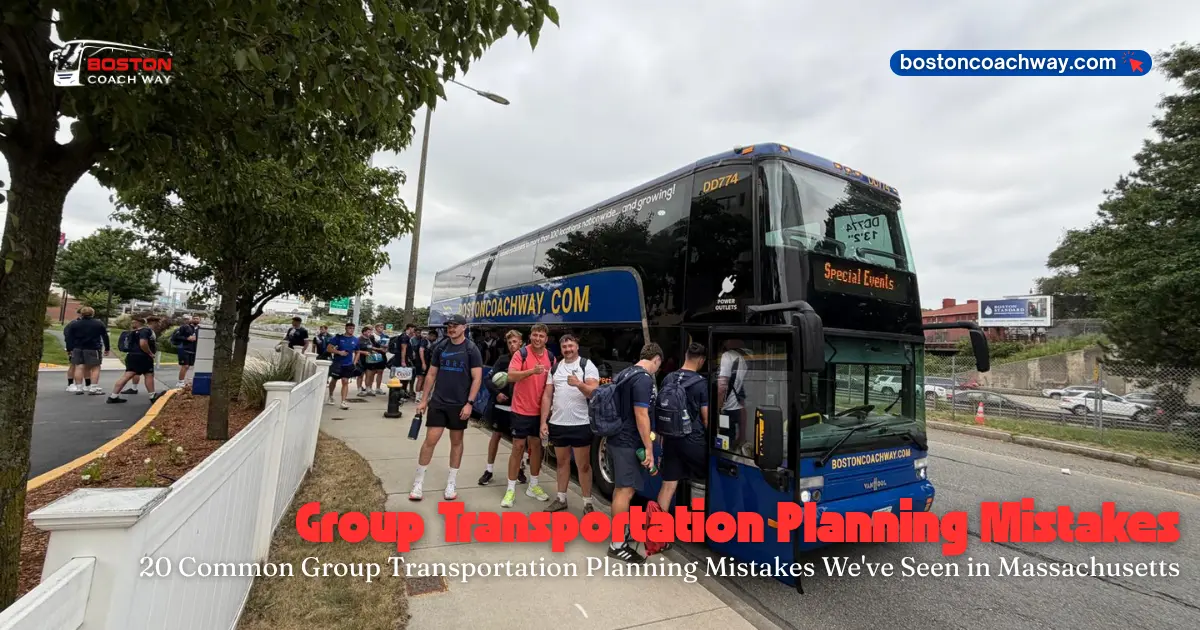





Group transportation planning involves more than reserving enough seats. A reliable transportation plan connects passenger count, vehicle capacity, luggage space, pickup locations, loading access, schedules, and driver coordination. Small planning gaps can affect an entire itinerary, especially for weddings, corporate events, school trips, sports groups, conferences, and multi-stop travel across Massachusetts.
This guide breaks down 20 common planning mistakes that can disrupt group travel in Massachusetts. It covers late booking, incorrect headcounts, unsuitable vehicles, tight itineraries, unclear pickup instructions, accessibility requirements, parking restrictions, event shuttles, and last-minute changes. It also explains how traffic, seasonal conditions, and local events can affect travel times. The goal is to help planners identify these issues early and build a transportation plan that works from the first pickup to the final drop-off.
Table of Contents
1. Booking Transportation Too Late
Booking transportation too late can limit vehicle availability, scheduling options, and flexibility. Charter bus availability depends on the travel date, vehicle type, passenger count, service duration, and transportation demand. Industry guidance & we commonly recommends booking several months ahead, with some providers suggesting 3–6 months or longer for peak periods.
The issue becomes more significant for peak travel dates, large groups, multi-vehicle programs, and trips with several stops. A late request may require changes to the original itinerary simply because the preferred transportation configuration is unavailable. Early planning also gives the group time to finalize passenger numbers, luggage requirements, pickup locations, accessibility needs, and event schedules.
2. Planning Around an Outdated Passenger Count
An old headcount can make an otherwise detailed transportation plan inaccurate. Guest lists change. Employees register late. Students drop out. Event attendees bring additional guests. Each change can affect the required vehicle capacity and the number of vehicles assigned to a trip.
Passenger count is also only one part of capacity planning. Luggage, equipment, mobility devices, and seating requirements can change the practical transportation requirement. A group that grows from 42 to 50 passengers, for instance, may require a different vehicle configuration. Keeping the headcount current helps planners review vehicle assignments, shuttle frequency, loading times, and passenger communications before travel day.
3. Choosing a Vehicle Based Only on Seat Count
A vehicle that has enough seats is not automatically the right vehicle for the trip. The passenger profile matters just as much as the numerical capacity. Luggage, sports equipment, musical instruments, mobility equipment, trip duration, and the number of stops can all affect vehicle selection.
Consider two groups of 40 passengers. One carries small personal bags for a short conference transfer. The other carries suitcases and sports equipment for a multi-day tournament. Their transportation requirements are different despite having the same headcount. Vehicle selection therefore works best when planners consider seating capacity together with cargo space, accessibility, itinerary length, and the way passengers will use the vehicle.
4. Forgetting to Plan for Luggage, Equipment, and Cargo Space
Passenger seats tell only part of the transportation story. Cargo requirements can change the vehicle configuration even when the passenger count stays the same. Suitcases, sports bags, musical instruments, event materials, strollers, and other large items require practical storage space.
This becomes particularly relevant for airport transfers, sports teams, school groups, and overnight trips. A coach carrying 30 travelers with luggage has different space requirements from a coach carrying 30 conference attendees with laptop bags. Identify the type and approximate volume of cargo during the planning stage. That information can then be considered alongside passenger capacity, boarding time, vehicle type, and the number of scheduled stops.
5. Creating a Schedule With No Buffer Time
A transportation schedule based entirely on estimated driving time leaves little room for passenger loading, traffic, venue access, or other delays. Travel time and operational time are separate planning factors. A vehicle can reach the area on schedule and still arrive late at the final destination because passengers took longer to board.
This matters when transportation connects to a fixed event time. A conference shuttle, airport transfer, wedding ceremony, or sports event has limited flexibility once the schedule is underway. A useful itinerary accounts for the movements around the drive itself. That includes passenger boarding, luggage handling, venue access, and the time required to complete earlier stops before the next scheduled movement.
6. Treating a Complex Itinerary Like a Simple Point-to-Point Trip
Not every group transportation plan is a single journey from A to B. A conference may involve hotel pickups, venue transfers, evening activities, and airport departures. A wedding can involve separate transportation between hotels, ceremony locations, reception venues, and return accommodations.
Each movement introduces another dependency. The first departure affects the next arrival. A delayed passenger group can affect a later pickup. A venue restriction can change where the vehicle waits. Breaking a complex itinerary into individual transportation legs makes these relationships visible. Each leg can then be reviewed for its pickup point, destination, passenger group, vehicle assignment, travel time, loading requirements, and connection to the next movement.
7. Using Vague Pickup and Drop-Off Locations
“Meet at the hotel” is not a transportation instruction. Large hotels, convention centers, universities, and event venues often have multiple entrances and different areas for passenger vehicles and buses.
A useful pickup instruction identifies the specific meeting point and the access point available to the vehicle. That may be a motorcoach loading area, a designated curb, a particular entrance, or another approved location. Without that information, passengers can wait at the wrong entrance while the driver waits elsewhere. Clear location details also make communication easier for event staff and reduce unnecessary vehicle repositioning during a scheduled pickup.
8. Failing to Verify the Actual Bus Loading Area
The destination listed on an itinerary does not necessarily identify where a charter bus can stop. A venue may have a separate motorcoach entrance, restricted curb, staging area, or designated loading zone.
This distinction matters in dense areas and at busy venues in Massachusetts. A full-size coach requires different access from a passenger car. If the planned entrance cannot accommodate the vehicle, the driver may need to use another location, and passengers may have to walk farther than expected. Verifying the actual bus access point before the trip allows the itinerary to reflect the physical location where passengers board and exit rather than simply the property’s mailing address.
9. Giving Different People Different Transportation Information
Conflicting instructions create avoidable confusion. One passenger may have an earlier pickup time in an email, while another receives a newer schedule through an event app. The driver may have a third version of the itinerary.
A group transportation plan benefits from a single current version of the essential travel information. Pickup time, meeting location, vehicle instructions, contact details, and major schedule changes can remain consistent across passenger communications and event staff instructions. This becomes more important as the number of passengers and vehicles increases. When a change occurs, updating the central itinerary first provides a reliable reference for everyone involved.
10. Failing to Align Drivers, Staff, and Event Schedules
Transportation does not operate separately from the event schedule. A driver may arrive at the planned pickup time, but passengers could still be inside a conference session, classroom, meeting, or reception.
The transportation schedule therefore works best when it is built against the actual event timeline. Session end times, passenger release periods, venue access, loading windows, and scheduled departures all affect vehicle movement. A 10-minute difference between the event schedule and the transportation schedule can become significant when several shuttle movements follow one another. Coordinating these schedules gives drivers, event staff, and passengers the same operational timeline.
11. Not Assigning a Dedicated Transportation Coordinator
Someone needs ownership of the transportation details. Without a designated coordinator, passenger questions, itinerary changes, driver communication, and event-staff requests can move between several people without a clear decision-maker.
The coordinator does not necessarily manage every part of the event. The role is narrower: maintain the transportation schedule, keep passenger information current, communicate operational changes, and provide a clear contact for transportation issues. This becomes particularly useful when several vehicles or pickup locations are involved. A conference, for example, may have an event manager, hotel contact, venue representative, and transportation provider. One transportation contact keeps those separate responsibilities connected.
12. Treating Event Shuttle Logistics as an Afterthought
A shuttle program requires more than assigning buses to an event. Passenger flow determines how many movements are required and when they need to occur. A group of 300 attendees does not necessarily travel as one group at one time.
Hotel locations, event start times, passenger arrival patterns, vehicle capacity, and return schedules all influence shuttle operations. For a conference with attendees staying at several hotels, multiple pickup waves may be more practical than a single departure. A wedding may require separate arrival and return movements. Planning these details early helps establish routes, pickup windows, vehicle assignments, and communication procedures before passengers begin moving.
13. Assuming Your Charter Bus Reservation Is Fully Confirmed
A transportation discussion is not the same as a finalized transportation plan. Important details can remain unresolved after an initial quote or booking conversation, including pickup locations, service times, vehicle requirements, passenger count, accessibility needs, or additional stops.
Before travel day, compare the current itinerary against the confirmed transportation details. The vehicle configuration and service schedule need to match the trip that is actually taking place. This review becomes especially important after changes. An updated passenger count or an added destination can affect the original arrangement. Treating confirmation as a documented review of the complete transportation requirements reduces the chance of discovering an unresolved detail on the day of travel.
14. Overlooking Charter Bus Parking, Loading Zones, and Local Restrictions
A charter bus needs somewhere to load, unload, and, when applicable, wait between movements. Those locations are not always the same as the passenger entrance. Curb restrictions, roadway dimensions, designated loading zones, parking rules, and vehicle access can affect where a coach can operate.
The issue is especially relevant for busy downtown areas and major Massachusetts events. A venue may direct motorcoaches to a specific staging location rather than its main entrance. That information belongs in the itinerary. Once the actual loading and parking arrangements are known, planners can provide passengers with accurate meeting instructions and allow the schedule to reflect any additional walking or vehicle positioning time.
15. Neglecting End-of-Event Shuttle Planning
The end of an event often creates a different transportation pattern from the arrival. Hundreds of passengers may leave at once, while others remain behind for networking, cleanup, photographs, or post-event activities.
A return plan can therefore identify more than a final departure time. It can establish where vehicles wait, how passengers find the correct shuttle, when the first departure occurs, and how later departures are handled. Weddings and conferences are common examples where passenger release times vary. Without a defined return procedure, the group may have a clear arrival plan but no equally clear method for getting everyone back to hotels, residences, airports, or other destinations.
16. Ignoring Accessibility and Passenger-Specific Requirements
Accessibility requirements can affect the vehicle, pickup location, boarding process, seating arrangement, and schedule. They are therefore transportation planning details, not last-minute passenger notes.
A group may include wheelchair users, passengers with mobility limitations, older adults, children, or travelers with other specific requirements. The relevant needs vary by passenger and trip. Identifying them early allows the transportation team to determine the appropriate vehicle and boarding arrangement. It also allows the itinerary to account for loading time and suitable access points. Keeping these requirements in the planning record prevents passenger needs from becoming an unexpected operational issue on travel day.
17. Choosing a Transportation Provider Based Only on Price
A transportation quote represents a service configuration, not simply a number. Two quotes with similar passenger capacity can differ in vehicle type, service hours, mileage, stops, accessibility provisions, or other trip requirements.
Price comparison becomes more useful when every provider is evaluating the same itinerary. A planner can compare the included vehicle, operating hours, destinations, additional stops, and other requirements alongside the quoted cost. This prevents an inexpensive quote from appearing equivalent to a broader transportation service when the underlying scope differs. Provider selection is therefore part of transportation planning itself. The relevant question is not only what the trip costs, but what transportation service the quoted price actually represents.
18. Making Last-Minute Changes Without Rechecking the Entire Itinerary
Changing one detail can create several new timing or routing problems. Moving a pickup, adding a stop, increasing the passenger count, or changing the destination can affect the vehicle assignment and every movement that follows.
Suppose a hotel pickup moves 30 minutes later. The later departure may reduce the time available for the scheduled venue arrival. That can then affect an evening shuttle or return trip. Rather than changing one line in the itinerary, review the complete sequence after a significant modification. Recheck passenger counts, vehicle assignments, travel times, loading points, event times, driver instructions, and passenger communications. The objective is to keep the entire transportation plan internally consistent.
19. Failing to Have a Contingency Plan
A contingency plan defines what happens when the original transportation schedule no longer works. It can address traffic delays, weather, vehicle problems, passenger delays, venue changes, or an event running beyond its scheduled time.
The useful part is not predicting every possible disruption. It is deciding who communicates the change and what information changes with it. For example, a delayed event departure may require a new passenger meeting time and updated driver instructions. A weather-related change may affect the route or loading location. Identifying the transportation coordinator, communication channel, alternate instructions, and decision-making process in advance gives the group a defined response when the original itinerary changes.
20. Ignoring Local Traffic, Events, Road Restrictions, and Seasonal Conditions
Travel time in Massachusetts is influenced by more than the distance between two addresses. Boston-area congestion, construction, major events, winter weather, seasonal travel, and road restrictions can all affect a group’s transportation schedule.
The effect becomes more significant when an itinerary has a fixed arrival time. A group traveling to a conference, airport, sporting event, wedding, or scheduled tour has less flexibility than a group taking an open-ended sightseeing trip. Reviewing known conditions during itinerary development helps planners adjust departure times, buffer periods, loading arrangements, and contingency procedures. Seasonal destinations can require additional consideration as well. Cape Cod summer travel, for example, creates a different planning context from an ordinary weekday transfer in Boston.
How to Avoid Common Group Transportation Planning Mistakes
Preventing group transportation problems starts with building the itinerary around the actual transportation requirements, not just the number of passengers. Review the travel date, current headcount, vehicle capacity, luggage, accessibility requirements, pickup locations, loading areas, event schedule, and return movements before finalizing the plan.
Use these 10 planning practices to address the 20 mistakes we covered above:
- Start transportation planning several months before the travel date. Early planning provides more time to evaluate vehicle availability, capacity, service hours, and complex itineraries.
- Keep passenger information current. Update the headcount as registrations, guest lists, employees, students, or team members change. Include luggage, equipment, and mobility requirements in the same review.
- Select vehicles based on the complete trip profile. Consider seating capacity, cargo space, accessibility, trip duration, number of stops, and passenger requirements rather than seat count alone.
- Build the itinerary around realistic travel and loading times. Add appropriate time for passenger boarding, luggage handling, traffic, venue access, and transitions between scheduled movements.
- Verify every pickup, drop-off, loading, and parking location. Confirm where the actual vehicle can stop and give passengers the same specific meeting-point instructions.
- Maintain one current transportation itinerary. Keep pickup times, locations, vehicle assignments, driver information, and schedule changes consistent across planners, staff, drivers, and passengers.
- Assign one person to coordinate transportation. A dedicated coordinator can manage itinerary updates, passenger questions, driver communication, and day-of transportation issues.
- Plan both arrival and departure transportation. Event shuttles require defined routes, passenger waves, vehicle staging, return procedures, and communication plans rather than a single arrival schedule.
- Review the complete plan after every significant change. Recheck vehicle assignments, passenger counts, travel times, loading areas, event schedules, and return movements instead of changing one itinerary detail in isolation.
- Prepare for local and unexpected conditions. Review Boston, Massachusetts traffic, construction, major events, seasonal travel, weather, road restrictions, and venue conditions. Define who communicates changes and how the group responds when the original schedule no longer works.
How to Plan Group Transportation in Massachusetts?
Planning group transportation in Massachusetts starts with the trip requirements and ends with a confirmed day-of schedule. Follow these 10 steps to organize the transportation process:
- Define the purpose and scope of the trip. Identify whether the transportation is for a wedding, corporate event, school trip, sports team, conference, airport transfer, or another group activity. Record the travel date, service duration, destinations, and expected passenger count.
- Create a transportation brief. Record passenger numbers, luggage, equipment, accessibility requirements, preferred departure times, number of stops, and any fixed arrival times. This gives transportation providers the information needed to evaluate the trip accurately.
- Map the complete route. List every pickup, destination, intermediate stop, event movement, and final drop-off. Separate one-way transfers from multi-stop or shuttle transportation so each movement can be scheduled correctly.
- Identify location-specific requirements. Check hotel entrances, venue access points, airport meeting areas, parking arrangements, loading zones, and other restrictions along the route. Record the exact passenger meeting point for each location.
- Match the vehicle to the group. Compare the passenger count with seating capacity, luggage space, equipment requirements, accessibility, and itinerary complexity. A larger group may also require multiple vehicles or scheduled passenger waves.
- Build the transportation schedule. Set departure times based on required arrival times, route conditions, passenger loading, luggage handling, and the time required at each stop. Keep fixed events such as ceremonies, flights, games, and conference sessions at the center of the schedule.
- Coordinate transportation with the event. Compare the transportation schedule with venue hours, event sessions, hotel check-in or checkout times, passenger release periods, and planned activities. This prevents transportation movements from conflicting with the main itinerary.
- Confirm the transportation arrangement. Review the vehicle, passenger count, service hours, locations, stops, accessibility requirements, and other trip details with the transportation provider. Update the plan when any requirement changes.
- Prepare passenger instructions. Give everyone the same pickup time, meeting location, destination information, and transportation contact details. Use specific locations rather than general directions such as “meet at the hotel.”
- Complete a final pre-trip review. Recheck the passenger count, itinerary, vehicle assignments, pickup points, event schedule, traffic conditions, weather, and return transportation. Keep one current itinerary for the transportation coordinator, event staff, and drivers.

What Should You Consider Before Renting a Charter Bus?
Before renting a charter bus, consider safety record, your group size, travel itinerary, vehicle capacity, luggage requirements, trip duration, pickup and drop-off locations, accessibility needs, amenities, pricing, and transportation provider. These factors help determine whether the selected bus and service arrangement fit the actual trip.
For a detailed breakdown of the key factors, see 15 Important Things to Consider Before Getting a Charter Bus Rental in Boston.