




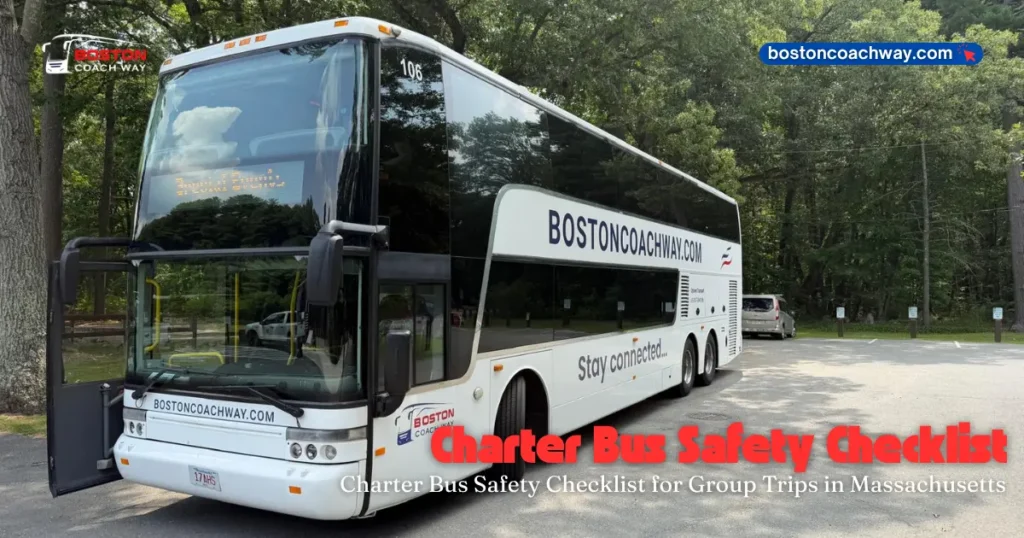
Safety should be the first priority when planning group transportation in Massachusetts. A charter bus safety checklist helps organizers evaluate a bus company’s credentials, review its safety records, confirm driver qualifications and insurance, and identify visible vehicle hazards before boarding. These checks help reduce avoidable risks for school trips, corporate events, sports teams, weddings, and other group journeys.
For trips in Boston and across Massachusetts, safety planning involves more than inspecting the bus. Organizers must also verify applicable state and federal requirements, review the route and driver’s schedule, confirm emergency exits, and prepare passengers for unexpected situations.
This guide we will explains what to verify before booking a charter bus, what to inspect before departure, and how to prepare passengers for emergencies. These checks help group planners make informed transportation decisions and plan a safer trip.
Table of Contents
What Should a Charter Bus Safety Checklist Include?
A charter bus safety checklist should cover the transportation company’s credentials, driver qualifications, insurance coverage, vehicle condition, emergency equipment, and trip arrangements. For group trips in Massachusetts, organizers should verify these details before booking, inspect the bus before boarding, and confirm that passengers know what to do if a safety issue occurs.
A charter bus safety checklist should include the following:
- Company credentials: Confirm the operator has the required state or federal operating authority for the planned trip.
- Safety records: Review the company’s available safety ratings, inspection history, and reported violations.
- Driver qualifications: Verify that the driver holds the appropriate commercial driver’s license (CDL) and passenger endorsement, where required.
- Insurance coverage: Confirm that the company maintains the insurance required for its operations.
- Vehicle inspection and maintenance: Check the bus’s inspection status, maintenance history, tires, brakes, lights, and other essential components.
- Emergency equipment: Locate emergency exits, fire extinguishers, first-aid supplies, and other required safety equipment.
- Passenger capacity and accessibility: Ensure the bus suits the group size and any mobility or accessibility requirements.
- Route and schedule: Review the planned route, pickup locations, rest stops, weather conditions, and driver schedule.
- Passenger safety procedures: Explain boarding rules, emergency instructions, passenger headcounts, and communication procedures.
- Breakdown and emergency planning: Establish whom to contact, where passengers should wait safely, and how the group will receive updates if the bus breaks down or travel is interrupted.
Use this checklist as a starting point, then adapt it to the trip type, passenger needs, and applicable Massachusetts and federal requirements.
What Safety Factors Should You Check Before Booking a Charter Bus?
Before booking a charter bus in Massachusetts, check these 10 safety factors:
- Verify the Charter Bus Company’s Credentials
- Review the Company’s Safety Records
- Confirm the Driver’s Qualifications
- Validate the Insurance Coverage
- Check the Bus’s Inspection and Maintenance Status
- Inspect the Bus Before Boarding
- Verify Emergency Equipment and Exit Access
- Match the Bus to Your Group’s Requirements
- Review the Route and Driver’s Schedule
- Establish a Passenger Safety Plan
1. Verify the Charter Bus Company's Credentials
Verifying a charter bus company’s credentials means confirming that the operator has the registrations, licenses, and operating authority required to provide your planned transportation service. This check helps you assess whether a provider is legitimate and authorized to transport passengers on your planned route.
Before booking a bus, check the following:
- Operating authority: Confirm that the company has the required state or federal authority for its operations.
- USDOT number: For applicable carriers, verify the company’s U.S. Department of Transportation identification number.
- MC operating authority: Check whether the company needs and holds applicable federal operating authority for interstate passenger transportation.
- Business information: Compare the company’s legal name and contact details with official regulatory records.
- Massachusetts authorization: For qualifying intrastate bus services, check applicable state requirements and authorization.
How to check the company’s credentials:
For interstate trips, use the FMCSA Passenger Carrier Search to look up the company by name or USDOT number. Review its registration and safety information, and use the FMCSA Licensing and Insurance Search to check applicable federal operating authority and insurance records. For trips that begin and end within Massachusetts, consult the state’s DPU list of regulated bus companies. The DPU oversees qualifying intrastate bus services, while interstate trips fall under federal oversight.
If the company’s records are missing, inactive, or inconsistent with the information it provided, ask for clarification before paying a deposit. Do not rely solely on a company’s website or verbal assurances; verify its credentials through the appropriate official sources.
2. Review the Company's Safety Records
Reviewing a charter bus company’s safety records means checking its available inspection history, safety rating, regulatory violations, and compliance information. These records help you assess the operator’s compliance history and identify potential safety concerns before booking.
Before booking a charter bus, check the following:
- Safety rating: Review the company’s current federal safety rating, if applicable. An FMCSA rating of Unsatisfactory is a serious concern because carriers with this rating are prohibited from operating.
- Inspection history: Look for vehicle inspection results and patterns of safety-related deficiencies.
- Regulatory violations: Check available records for violations involving vehicle maintenance, driver qualifications, or hours-of-service rules.
- Out-of-service indicators: Look for relevant vehicle or driver out-of-service results in available inspection data.
- Complaint and incident history: Ask the company about significant safety incidents and how it addressed them. Public records may not include every complaint or incident.
How to check a company’s safety records:
Use the FMCSA SAFER Company Snapshot to search by company name or USDOT number and review available safety ratings, inspection summaries, out-of-service data, and crash information. You can also check the FMCSA Safety Measurement System for passenger-carrier safety performance data.
Interpret the results carefully. FMCSA warns that SMS data alone should not be treated as a definitive judgment of a carrier’s overall safety. Look for serious concerns or recurring patterns, and ask the company to explain any relevant findings before booking. If records indicate an Unsatisfactory federal safety rating or an order to stop operating, do not proceed until the issue is resolved.
3. Confirm the Driver's Qualifications
Confirming bus driver’s qualifications means verifying that the driver holds the appropriate commercial driver’s license (CDL), endorsements, and medical certification required for the vehicle and service. Qualified drivers help protect passengers by meeting the training, licensing, and eligibility requirements for operating a commercial passenger vehicle.
Before booking a bus, check the following:
- Commercial driver’s license (CDL): Confirm that the driver has the correct license class for the vehicle.
- Passenger endorsement: Check that the driver holds a passenger (P) endorsement when required for the bus.
- School bus endorsement: If the trip involves a school bus, verify any additional licensing and certification requirements that apply.
- Medical qualification: Confirm that the driver meets applicable commercial driver medical requirements.
- Hours-of-service compliance: Ask how the company schedules drivers to comply with applicable driving-time and rest requirements.
- Training and experience: Ask about the driver’s experience operating similar buses and handling passenger trips, including challenging road or weather conditions.
A valid license alone is not enough. The driver must also meet applicable fitness-to-drive requirements and operate the vehicle safely. A booking confirmation does not, by itself, establish that the assigned driver meets every requirement.
How to check the driver’s qualifications:
Ask the charter bus company to confirm the assigned driver’s license class, passenger endorsement, medical qualification, and relevant experience. For Massachusetts trips, review the state’s CDL classes and endorsements and applicable motor bus driver certificate requirements. For covered interstate operations, consult the FMCSA passenger-carrier driver qualification guidance.
You can also ask how often the company reviews driving records, enforces rules against texting while driving, and manages drug and alcohol testing where required. FMCSA recommends checking these practices when evaluating a passenger carrier.
Important: Requirements vary by vehicle, service, and whether the trip is intrastate or interstate. If the company cannot clearly explain how it verifies driver qualifications, ask for clarification before booking.
4. Validate the Insurance Coverage
Validating a charter bus company’s insurance coverage means confirming that the operator maintains the liability insurance required for its transportation services. This coverage matters because an accident or passenger injury can result in substantial medical expenses, property damage, and liability claims. Checking insurance before booking helps you understand whether the company meets applicable requirements and whether its coverage applies to your trip.
Before booking a charter bus, check the following:
- Liability insurance: Confirm that the company maintains the minimum coverage required for its vehicle and type of operation.
- Coverage limits: Ask for the policy’s liability limits and verify that they meet applicable state or federal requirements.
- Policy validity: Check that the insurance policy is active for the planned travel dates.
- Carrier information: Ensure the insured company’s legal name matches the transportation provider you intend to hire.
- Trip applicability: Confirm that the policy covers the planned passenger service, including interstate travel if your journey crosses state lines.
- Proof of insurance: Request a current certificate of insurance or other appropriate documentation.
Insurance requirements can vary depending on passenger capacity, vehicle type, and whether the trip is intrastate or interstate. Do not assume that a company’s general business insurance automatically covers charter bus passenger transportation.
How to check the company’s insurance coverage:
For interstate charter services, use the FMCSA Licensing and Insurance Search to review available federal insurance filings. FMCSA generally requires qualifying for-hire interstate passenger carriers to maintain at least $5 million in liability coverage for vehicles designed to carry 16 or more people, including the driver, or $1.5 million for vehicles designed for 15 or fewer. Exceptions apply to certain operations.
For qualifying intrastate bus services in Massachusetts, consult the Massachusetts DPU’s passenger-carrier requirements and ask the company for current proof of insurance.
Before paying, verify that the documents match the operator’s legal name and that the policy remains active for your trip dates. If coverage details are unclear, ask the company or its insurance provider to confirm them in writing.
5. Check the Bus's Inspection and Maintenance Status
Checking a bus’s inspection and maintenance status helps you determine whether the vehicle receives required safety inspections, routine servicing, and necessary repairs. Regular maintenance helps identify mechanical problems before a trip and reduces the risk of breakdowns caused by preventable defects. For group transportation in Massachusetts, these checks are especially important when the journey involves long distances, heavy traffic, or changing weather conditions.
Before booking, ask the charter bus company about the following:
- Inspection records: Confirm that the bus has completed all required inspections for the vehicle and its operation, and that its records are current.
- Preventive maintenance: Ask how often the company services its fleet and follows the manufacturer’s maintenance recommendations.
- Brake system: Check whether brakes receive routine inspections and repairs when needed.
- Tires and wheels: Ask about tire condition, tread depth, inflation, and checks for damage.
- Lights and signals: Confirm that headlights, brake lights, turn signals, and hazard lights are maintained.
- Steering and suspension: Ask whether these systems are included in routine mechanical inspections.
- Defect reporting: Find out how drivers report mechanical issues and whether buses with safety-critical defects are removed from service until repaired.
A clean-looking bus is not necessarily in good mechanical condition. Maintenance records and documented inspections provide stronger evidence than appearance alone.
How to check the bus’s inspection and maintenance status:
Ask the company for the specific bus’s latest inspection documentation and relevant maintenance records. For applicable interstate passenger carriers, the FMCSA inspection, repair, and maintenance guidance explains federal requirements for vehicle upkeep and recordkeeping.
Before departure, also ask whether the driver performs a pre-trip inspection and whether any safety-related defects have been repaired. If the company cannot provide clear answers or reports an unresolved problem with brakes, tires, steering, or another critical system, request a different bus rather than risk the group’s safety.
6. Inspect the Bus Before Boarding
Inspecting a charter bus before boarding means checking its visible condition and passenger areas before your group begins the journey. This step helps you identify visible safety hazards, damage, or cleanliness issues that may not be apparent when booking online. For group trips in Massachusetts, a quick pre-boarding inspection allows organizers to raise concerns before passengers enter the vehicle.
Before boarding, check the following:
- Tires and exterior: Look for visibly damaged tires, fluid leaks, body damage, or loose exterior components.
- Lights and mirrors: Check that visible lights, turn signals, and mirrors appear intact.
- Doors and steps: Ensure boarding doors open properly and steps are stable and free from obvious hazards.
- Seats and seat belts: Check for damaged seats, loose fittings, or accessible seat belts where installed or required.
- Aisles and exits: Make sure aisles remain clear, and emergency exits are not blocked.
- Windows and windshields: Look for damage that could affect visibility or passenger safety.
- Interior condition: Check for loose objects, exposed wiring, slippery floors, or other visible hazards.
How to inspect the bus before boarding:
Ask the driver or company representative to address any concerns you notice. Do not attempt to inspect or repair mechanical components yourself. If you identify a serious defect, such as a damaged tire, blocked emergency exit, or unsafe boarding step, report it immediately and request that the company resolve the issue before departure. If the concern remains unresolved, ask for a replacement bus.
7. Verify Emergency Equipment and Exit Access
Verifying emergency equipment and exit access helps ensure that required safety equipment is available and that passengers can reach emergency exits without obstruction. These checks matter because a fire, collision, or mechanical breakdown may require passengers to leave the vehicle quickly. For group trips, organizers should know where emergency equipment is located before the bus departs.
Before boarding, check the following:
- Emergency exits: Identify emergency doors, windows, and roof exits where equipped. Make sure they are clearly marked and accessible.
- Fire extinguisher: Confirm that the required fire extinguisher is present, accessible, and appears properly secured.
- First-aid supplies: Ask whether first-aid supplies are available and where they are stored.
- Emergency windows and release mechanisms: Check that access points are not blocked by luggage or other objects.
- Emergency communication: Confirm how passengers can alert the driver if a problem occurs.
- Evacuation instructions: Ask the driver where passengers should exit and where they should gather if evacuation becomes necessary.
- Aisles and doorways: Ensure bags and personal belongings do not obstruct evacuation routes.
How to check emergency equipment and exits:
Ask the driver to point out the emergency exits and explain the basic evacuation procedure before departure. Do not operate emergency equipment unnecessarily or assume every bus has identical features. If an exit is blocked, required equipment appears missing, or the driver cannot explain the emergency procedure, ask the company to resolve the concern before the journey begins.
8. Match the Bus to Your Group's Requirements
Matching the charter bus to your group’s requirements means choosing a vehicle with suitable passenger capacity, luggage space, accessibility features, and amenities for the planned trip. The right bus accommodates the group without exceeding its approved passenger capacity or creating avoidable safety concerns. For group travel in Boston, consider both the number of passengers and the journey’s length when selecting a vehicle.
Before booking, check the following:
- Passenger capacity: Confirm that the bus can accommodate everyone within its approved seating capacity.
- Luggage storage: Ensure there is enough storage for suitcases, sports equipment, school supplies, or event materials without blocking aisles or emergency exits.
- Accessibility: Ask about wheelchair lifts, securement systems, and other accessibility features if passengers have mobility needs.
- Seat belts: Confirm whether seat belts are installed and available for passengers, and verify any applicable requirements.
- Trip duration: Choose a vehicle suitable for the journey, particularly for long-distance travel or full-day group outings.
- Passenger amenities: Check requirements for climate control, restrooms, Wi-Fi, or charging outlets where needed.
- Special group needs: Consider appropriate arrangements for school groups, sports teams, corporate events, or passengers requiring additional assistance.
How to check the bus’s suitability:
Give the charter bus company an accurate passenger count, luggage estimate, itinerary, and list of accessibility needs before requesting a quote. Ask the company to confirm the vehicle type and seating capacity in writing. Before departure, verify that the supplied bus matches the agreed requirements. If the vehicle is too small or lacks an essential accessibility feature, request a suitable replacement before boarding.
9. Review the Route and Driver's Schedule
Reviewing the route and driver’s schedule confirms the planned journey, pickup and drop-off locations, travel time, and arrangements for driver breaks. This check helps group planners anticipate delays, identify unsuitable routes, and reduce the risk of fatigue-related driving problems caused by unrealistic schedules. For charter bus trips in Massachusetts, traffic congestion around Boston, road construction, and winter weather can affect travel times.
Before booking, check the following:
- Planned route: Confirm the main roads, destinations, and any scheduled stops.
- Pickup and drop-off points: Verify addresses, meeting locations, and safe areas for passengers to board and exit.
- Travel time: Allow reasonable time for traffic, road construction, weather, and unexpected delays.
- Driver’s hours: Ask how the company ensures the driver’s schedule complies with applicable driving-time and rest requirements.
- Rest stops: Plan suitable breaks for longer journeys when needed.
- Weather and road conditions: Check forecasts and potential travel disruptions before departure.
- Contingency arrangements: Confirm how the company will communicate route changes, delays, or closures.
How to check the route and driver’s schedule:
Request a written itinerary from the charter bus company and review it against your group’s event schedule. Check current traffic updates and Massachusetts road conditions for potential disruptions. Ask who will communicate changes during the journey and how the company handles unexpected delays.
For applicable interstate passenger operations, review the FMCSA hours-of-service guidance to understand relevant driver limits. If the itinerary appears unrealistic or leaves insufficient time for required rest, ask the company to revise it before confirming the booking.
10. Establish a Passenger Safety Plan
A passenger safety plan explains how the group will stay organized, follow safety instructions, and respond to unexpected situations during the trip. It helps trip organizers coordinate passengers, communicate with the driver, and reduce confusion during delays, breakdowns, or emergencies. For group transportation, a clear plan is especially useful for school field trips, corporate outings, sports teams, and large events.
Before departure, establish the following:
- Group leader: Assign a trip coordinator who can communicate with the driver and transportation company.
- Passenger headcounts: Decide when to count passengers, such as before departure, after stops, and when reaching each destination.
- Emergency contacts: Keep a list of important contacts, including the trip coordinator and the transportation company’s contact numbers.
- Passenger instructions: Explain safe boarding, remaining seated while the bus is moving, and following the driver’s directions.
- Emergency procedures: Make sure passengers know where emergency exits are located and how to respond to an evacuation instruction.
- Special assistance: Identify passengers who may need help during boarding, evacuation, or other emergencies, while respecting their privacy.
- Communication plan: Establish how the group will receive updates if the bus is delayed, changes route, or breaks down.
How to establish the plan:
Share the itinerary, meeting points, emergency contacts, and relevant safety instructions with passengers before the trip. Confirm the arrangements with the charter bus company and driver before boarding. For school groups, assign appropriate adult supervisors and establish student headcount procedures. Review the plan before departure so everyone understands their role and knows whom to contact if a problem occurs.
What Massachusetts Charter Bus Safety Regulations Should You Know?
Charter bus safety in Massachusetts is governed by state rules for regulated intrastate carriers and federal requirements for applicable interstate operations. These rules cover driver qualifications, vehicle inspections, and insurance. The requirements depend on the vehicle, operator, passenger service, and route.
The following regulations and official resources help group organizers understand what to verify before booking a charter bus.
Safety Regulation or requirement | What it means for trip organizers | Evidence |
Massachusetts DPU operating authority | Qualifying intrastate motor bus carriers must hold the applicable state authority. | |
Federal operating authority | Applicable interstate for-hire passenger carriers require federal operating authority. | |
Driver credentials | Drivers must meet the license, endorsement, and state certification requirements that apply to their operation. | |
Vehicle inspection and maintenance | Covered carriers must comply with applicable inspection, repair, and maintenance requirements. | |
Insurance | Applicable carriers must meet the financial responsibility requirements for their operation. | |
Driving and on-duty limits | Covered passenger-carrier drivers must comply with applicable hours-of-service rules. | |
Commercial vehicle safety rules | Massachusetts adopts applicable motor carrier safety regulations for covered vehicles and operations. |
What Are the Most Important Safety Checks for School, Corporate, and Sports Groups?
The most important safety checks depend on the group’s passengers, luggage, destination, and supervision needs. Every group needs a suitable vehicle, a qualified driver, appropriate insurance, and a safe itinerary, but additional checks help address the risks of specific trips.
Group type | Important safety checks |
School field trips | Verify the operator and driver credentials, confirm passenger capacity, assign chaperones, maintain a student roster, and explain emergency procedures. |
Corporate groups | Confirm pickup locations, passenger counts, venue access, return transportation, and communication responsibilities. |
Sports teams | Check luggage and equipment capacity, secure heavy items, plan rest stops, and allow realistic travel time. |
Wedding parties | Confirm venue-approved loading areas, late-night return arrangements, passenger counts, and a designated group contact. |
Airport transfers | Verify terminal pickup instructions, luggage capacity, flight-related schedule flexibility, and safe loading arrangements. |
Senior groups | Confirm accessible boarding arrangements, assistance requirements, comfortable seating, and appropriate stop planning. |
Groups with mobility needs | Discuss wheelchair access, securement, boarding assistance, and other agreed accessibility arrangements before booking. |
Sightseeing groups | Confirm the route, designated stops, safe passenger drop-off areas, and realistic timing at each destination. |
What Are the Warning Signs of an Unsafe Charter Bus Service?
Warning signs of an unsafe charter bus service include unverifiable operating authority, unclear insurance coverage, serious unresolved vehicle defects, unsafe driver behavior, and an itinerary that appears incompatible with applicable driving-hour limits. Any credible safety concern deserves investigation before the trip proceeds.
Look for these specific problems:
- Unverifiable company credentials: The operator cannot provide the information needed to verify its applicable state or federal authority.
- Prohibited safety status: The company has a final FMCSA Unsatisfactory safety rating, which prohibits it from operating.
- Unclear insurance: The operator cannot confirm current coverage for the proposed transportation service.
- Visible vehicle defects: Tires, lights, doors, or other components show damage that raises a credible safety concern.
- Obstructed emergency exits: Luggage or equipment blocks access to designated exits.
- Concerning driver behavior: The driver appears impaired, dangerously fatigued, distracted, or reckless.
- Unrealistic scheduling: The proposed itinerary appears to require speeding, inadequate rest, or driving beyond applicable limits.
- No clear breakdown procedure: The company cannot explain how it handles a mechanical failure or arranges replacement transportation.
A low quote or an older bus does not, by itself, prove that a service is unsafe. Evaluate the operator’s actual credentials, vehicle condition, maintenance procedures, and ability to meet applicable requirements.
What Should You Do if a Charter Bus Breaks Down or an Emergency Occurs?
If a charter bus breaks down or an emergency occurs, follow the driver’s safety instructions, move away from immediate danger when necessary, and call 911 if anyone faces an urgent threat to life or safety. The appropriate response depends on the type of emergency and the vehicle’s location.
For a mechanical breakdown, the driver should stop in a safe location when possible and contact the transportation company’s dispatch team. Passengers should remain in the vehicle if it is safe to do so. If the driver directs an evacuation, follow the instructions and move to a designated safe area away from traffic.
For a fire, heavy smoke, collision, or other immediate danger, alert the driver and follow the appropriate emergency procedure. Do not block exits, retrieve luggage from a dangerous vehicle, or walk into moving traffic. If someone experiences a serious medical emergency, call 911 and provide the location, the nature of the incident, and the number of people affected.
The trip coordinator should account for passengers, notify the operator, and communicate with the group. The operator can arrange roadside assistance or provide replacement transportation when necessary. Do not resume the journey until the safety concern has been addressed and the vehicle is suitable for continued travel.
Who Should I Contact During a Charter Bus Emergency?
Contact 911 for an immediate threat to life or safety, then notify the charter bus company’s dispatch team and the designated group coordinator when it is safe to do so. The driver should communicate the vehicle’s location and coordinate the appropriate response.
Who Is Responsible for Charter Bus Safety?
The charter bus company is responsible for meeting its applicable operating, vehicle maintenance, insurance, and driver qualification obligations. The driver is responsible for operating the vehicle safely and complying with applicable driving rules. Group organizers and passengers also contribute to safe travel.
A trusted charter bus company maintains appropriate operating authority, follows required inspection and maintenance procedures, verifies driver qualifications, and provides a suitable vehicle for the assignment. The company should also have procedures for reporting defects, responding to breakdowns, and addressing safety concerns.
Group organizers support these responsibilities by supplying accurate passenger counts, arranging appropriate supervision, confirming accessibility needs, and communicating itinerary changes. Passengers help by following safety instructions, wearing available seat belts, keeping aisles clear, and reporting hazards.
These responsibilities are complementary. A trip organizer’s checklist does not replace the operator’s legal obligations or the driver’s professional judgment.
What Should You Look for in a Safe Charter Bus Company?
Choose a charter bus company that can demonstrate the credentials, insurance, driver qualifications, maintenance procedures, and emergency arrangements applicable to your trip. Before confirming the booking, compare the company’s documentation with the assigned vehicle, planned itinerary, and group’s requirements.
Use these seven criteria when evaluating a provider:
- Verified operating authority: Confirm the company’s applicable Massachusetts or federal authorization.
- Reviewable safety records: Check available regulatory records and investigate significant concerns.
- Qualified drivers: Confirm applicable licensing, endorsements, and driver qualification procedures.
- Appropriate insurance: Request current documentation and verify the coverage relevant to the service.
- Maintained vehicles: Ask about inspections, preventive maintenance, defect reporting, and repairs.
- Suitable transportation: Match passenger capacity, luggage space, accessibility, and route requirements to the group.
- Clear emergency procedures: Confirm dispatch contacts, breakdown support, and passenger communication arrangements.
The booking agreement should also specify pickup locations, departure times, cancellation terms, and arrangements for vehicle substitutions. A written agreement helps clarify what the operator has committed to provide.
Use the charter bus booking checklist to review the wider booking considerations alongside the safety checks in this article. Before making a final decision, verify the applicable regulatory information independently and ask the company to resolve any unanswered safety questions.
Check safety before boarding, travel safely, and help keep everyone on your group trip safe.